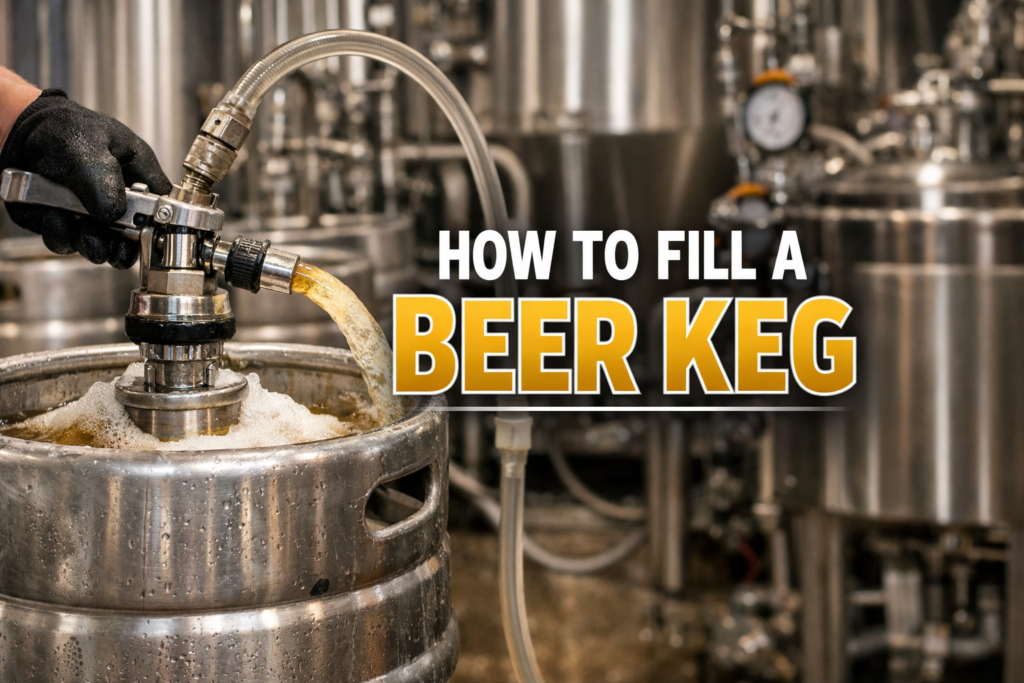
The annoying part is not getting beer into stainless steel. It is getting it there without turning a fresh batch into a flat-tasting, foamy mess three days later.
If you want the short answer on how to fill a beer keg, here it is: clean and sanitize the keg, purge it with carbon dioxide if you can, pick the transfer method that matches the fermenter sitting in front of you, run the beer to the bottom of the keg, stop before beer reaches the gas side, then chill and carbonate based on temperature.
That generic answer is fine. It is also incomplete. A bucket with a spigot, a pressure-capable fermenter, a hop-heavy IPA, and a plain stout do not all want the same transfer. I learned that the hard way years ago with a corny keg, a loose hose, and a pale ale that tasted bright on packaging day and tired by the weekend. The fill “worked.” The result did not.
What this guide will help you do
- Pick the right fill method for a bucket, a conical, or a pressure-capable fermenter
- Cut oxygen pickup without making keg day fussy for no reason
- Know when the keg is actually full
- Use pressure and temperature as decision tools, not magic numbers
- Fix foam, leaks, stale flavor, and gas-side beer without chasing the wrong culprit
Pick your transfer path in 30 seconds
| What you have | Best fill method | Watch for this |
|---|---|---|
| Bucket or basic fermenter with no pressure rating | Careful open gravity transfer | Splashing, hose above beer line, sloppy purging |
| Sealed fermenter sitting higher than the keg | Closed gravity transfer | Poor vent control on the receiving keg |
| Pressure-capable fermenter with CO2 setup | Closed CO2-pushed transfer | Too much pressure, stalled flow, beer pushed into the gas side |
Quick rule: the best method is the cleanest one the setup can really support, not the fanciest one in a forum thread.
Start with the short answer so the reader stops guessing
Here is the practical version.
Clean the keg. Sanitize the keg. If carbon dioxide is available, fill the keg with sanitizer and push that sanitizer out with low gas pressure so the inside is left full of CO2 instead of room air. Then transfer the beer as calmly as the setup allows, with the outlet hose reaching the bottom of the keg or filling through the liquid post. Stop before beer reaches the gas side. Seal the lid. Chill the keg all the way down. Then carbonate.
That order works because each step fixes a different failure point. Cleaning deals with residue. Sanitizing lowers microbial risk. Purging cuts oxygen exposure. Bottom filling cuts splashing. Chilling first makes carbonation and pour behavior predictable.
The weak version of keg advice skips the middle. It says “just transfer to the keg” as if every fermenter can do a tidy closed loop. It can’t. A plain plastic bucket with a spigot can still fill a Cornelius keg just fine, but the target is different: keep the path clean, keep the flow calm, and don’t pretend you are running a full pressure transfer when the vessel was never built for that.
Remember: “Full” does not mean squeezing every last ounce into the shell. It means enough room for clean sealing, clean carbonation, and no beer creeping up into the gas post.
If the beer is hop-forward, pale, or meant to stay bright for a while, be fussier about oxygen. If it is a stout or another beer that will get drunk fast, a careful gravity fill is often good enough. That is not laziness. That is matching the process to the beer.
Prep the keg so the transfer stays clean
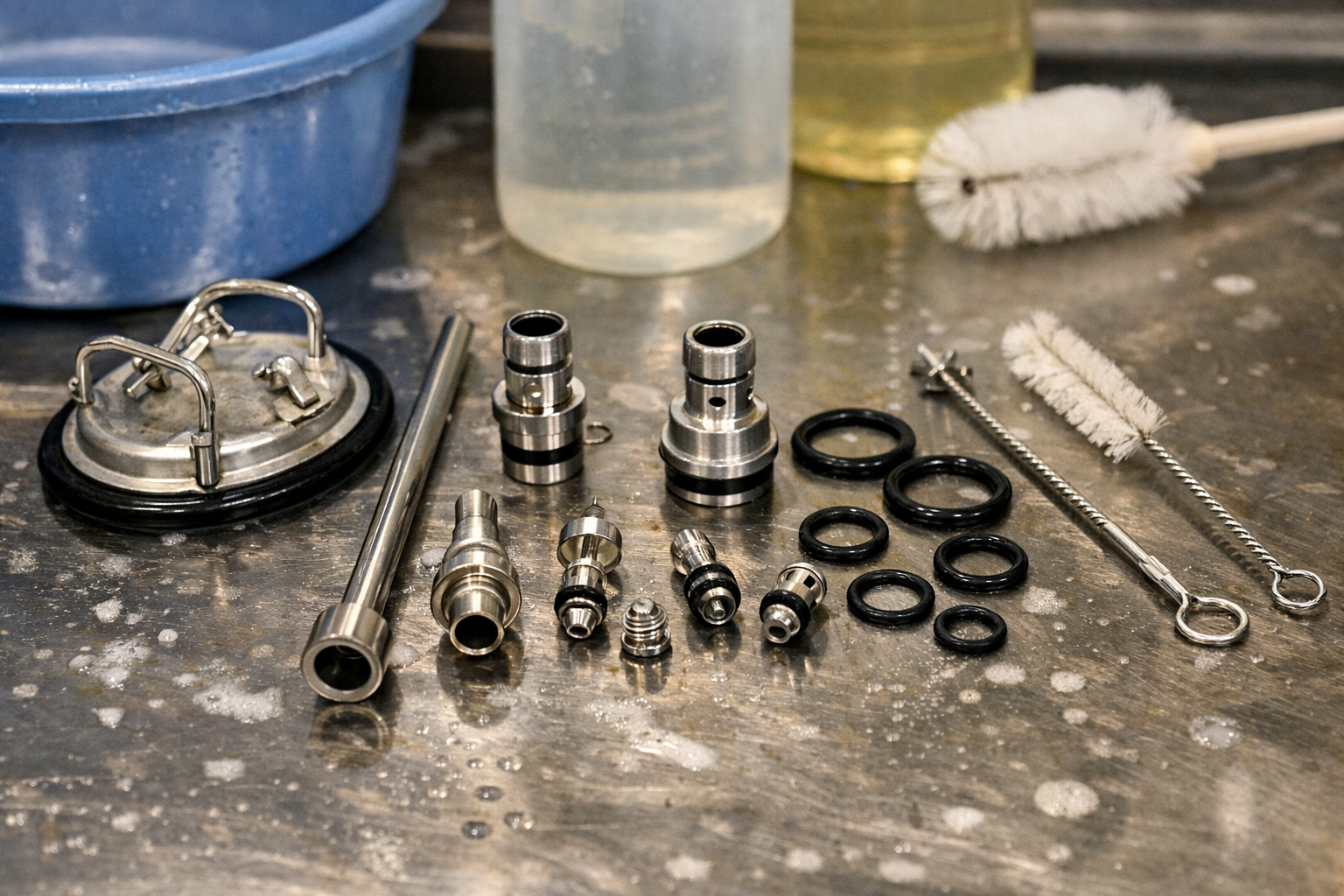
The University of Minnesota Extension’s guidance on cleaning and sanitizing food-contact surfaces draws a clean line between the two jobs. Cleaning removes soil and residue. Sanitizing lowers the number of microbes left behind. That is why a shiny keg can still be dirty in the places that matter.
On a corny keg, the places that matter are not just the shell. It is the liquid post, the gas post, the poppets, the long liquid dip tube, the short gas dip tube, the lid O-ring, and the post O-rings. Old beer likes to hide there. Dry hop dust likes to hide there too.
Clean the hidden parts so old residue does not tag along
Take the posts off if the keg is new to you or if the last batch finished with hop debris, fruit, or sticky adjuncts. Run cleaner through both sides. Look at the liquid dip tube and the poppets. If something smells sour and the batch was not supposed to be sour, keep cleaning.
Sanitize the full path so the beer sees one clean route
Once the keg is clean, run no-rinse sanitizer through the route the beer will actually use. That means the inside of the keg and the liquid side at minimum. If you can send sanitizer out through the serving side, you also confirm that the liquid path is open before any beer touches it.
Purge with CO2 so you are not filling a bucket of air
A common homebrew move is to fill the keg with sanitizer, then push the sanitizer out with low CO2 pressure. That leaves the inside mostly full of carbon dioxide instead of oxygen-rich air. It is one of those boring little steps that pays off later, mostly because you do not notice it. The beer just stays fresher.
Note: If the keg has a stubborn lid seal, wet the lid O-ring with sanitizer and seat the lid with a bit of pressure. A dry, tired O-ring can make you think the keg is leaking somewhere else.
Check for leaks before beer goes in
Pressurize the empty keg and spray the lid, posts, and fittings with sanitizer. Growing bubbles mean a leak. Fix that first. There is no prize for finding out after five gallons are inside.
The NIOSH carbon dioxide hazard guidance is plain about one thing: CO2 is colorless and odorless. Keep cylinders upright, keep the area ventilated, and do not shrug off a suspected leak in a small room. Homebrew gear looks friendly. The gas still deserves a bit of respect.
Choose the transfer method so the setup works the first time
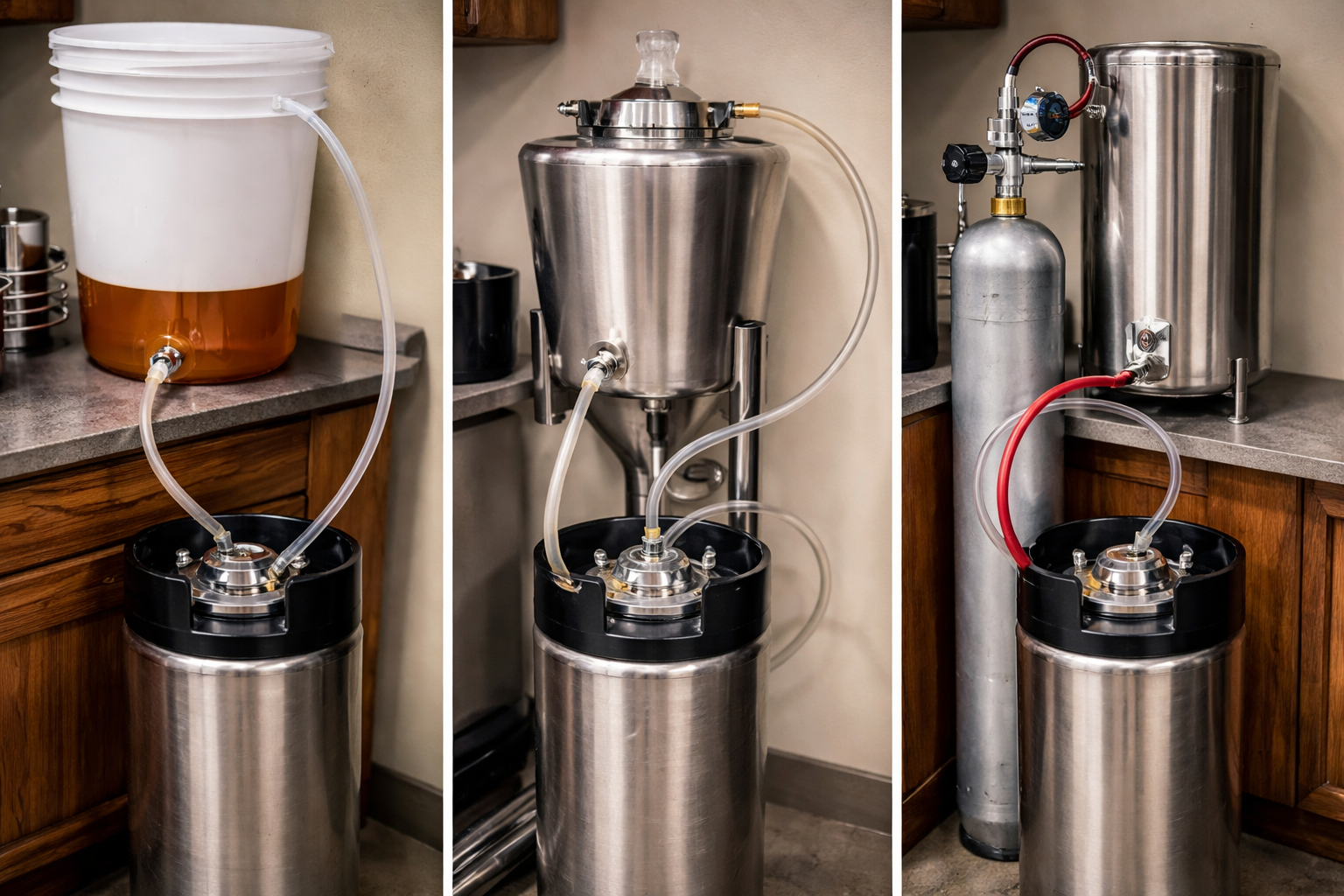
This is where kegging days either feel smooth or weirdly cursed. The method has to fit the fermenter. Not the dream fermenter. The one on the table.
| Method | What it needs | Oxygen risk | Best for |
|---|---|---|---|
| Open gravity transfer | Bucket or spigot fermenter, tubing, height | Higher | Simple setups, quick-drinking beers |
| Closed gravity transfer | Sealed fermenter, keg vent control, height | Lower | Pressure-capable or sealed fermenters above the keg |
| Closed CO2-pushed transfer | CO2 tank, regulator, sealed fermenter, disconnects | Lowest | Hoppy beers, lagers, awkward height setups |
Use open gravity when simplicity beats gear
If the fermenter is a bucket or another vessel that cannot safely hold pressure, use gravity. Put the fermenter above the keg. Run tubing to the bottom of the keg. Keep the flow calm. This is still good homebrewing when you do it neatly.
I would not do an open gravity transfer for a hazy IPA I planned to nurse for a month. I would happily do it for a dark mild that was going to disappear at a party. Same brewer. Same keg. Different beer, different risk.
Use closed gravity when the fermenter can stay sealed
If the fermenter can stay sealed and sit above the keg, a closed gravity transfer is a nice middle ground. The beer moves by gravity, the keg vents in a controlled way through the pressure relief valve or a spunding valve, and the beer sees far less oxygen than it would in an open fill.
Push with CO2 when the beer or the setup asks for it
If the fermenter is pressure-capable and you have a CO2 tank, regulator, and the right ball lock or pin lock fittings, a low-pressure closed transfer is the cleanest option. Think gentle pressure, not brute force. Many homebrew setups start with the source around 5 to 10 PSI and the receiving keg vented lower, often with a spunding valve sitting around 2 to 5 PSI. Those are starting points, not commandments.
Pro tip: If the transfer is surging or blasting foam through the line, the pressure is not “strong.” It is wrong. Back it down and vent the receiving keg a little more gently.
The point is not to chase a magical number. The point is to keep the beer moving without turbulence. If the fermenter is not built for pressure, stop right there and do not improvise with clamps and hope. That is the most common avoidable mistake in this whole topic.
The Master Brewers Association article on dissolved oxygen is written for brewing pros, but the lesson carries straight into a home brewery: once fermentation is done, oxygen pickup costs flavor stability. So when the beer is pale, hoppy, or delicate, closed transfer earns its keep.
Fill from the bottom so oxygen and foam stay down
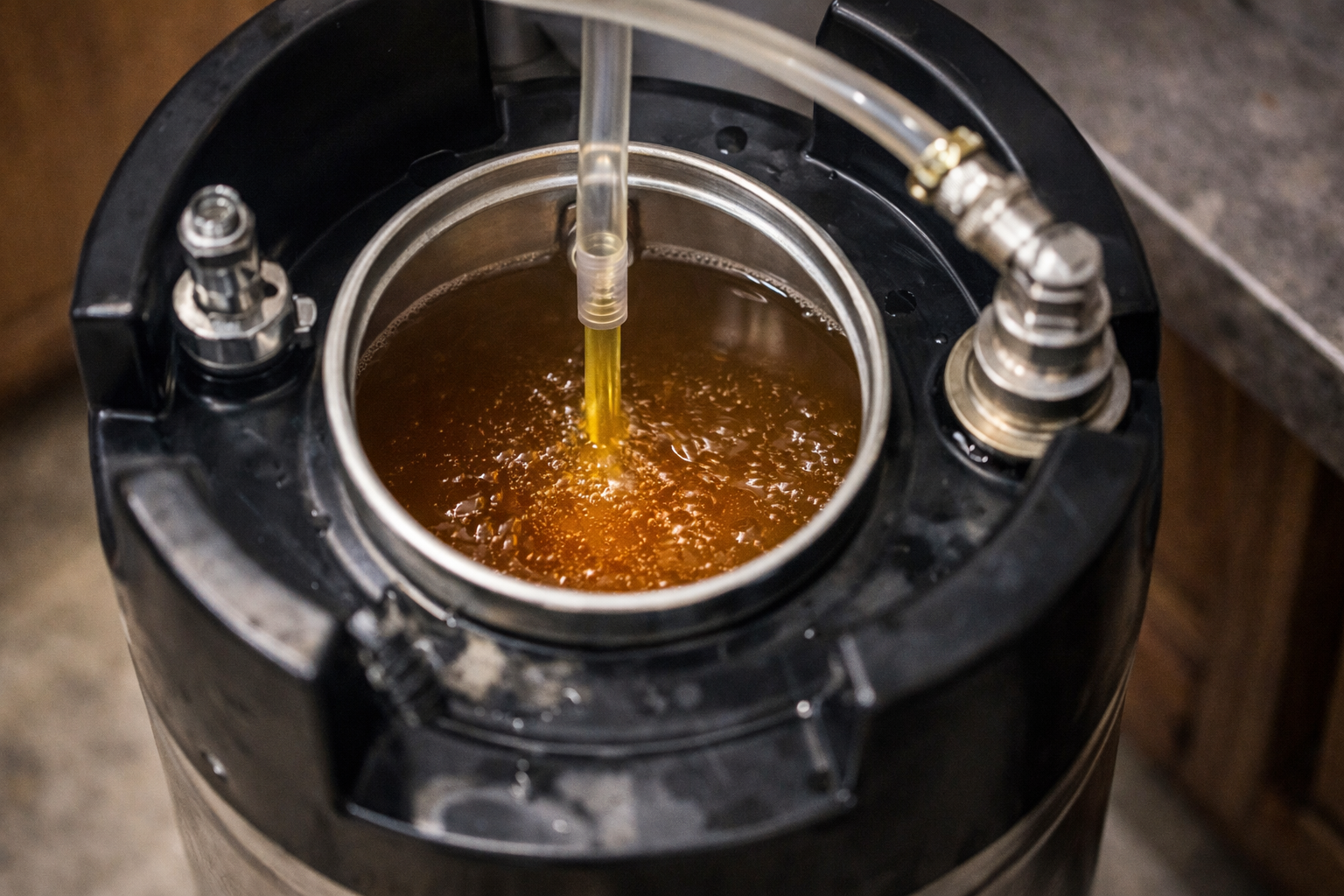
This is the part that changes the result fast. If the beer drops from above and splashes around in the keg, you are stirring in air and foam. If the beer enters at the bottom and rises quietly, the transfer behaves.
Run the beer to the bottom so the keg fills calmly
For an open fill, push sanitized tubing down into the keg so the outlet stays below the liquid line as the keg fills. For a closed fill, send the beer through the liquid post so it travels down the liquid dip tube and rises from the bottom. That is why the liquid side matters here. It is doing the same job the hose does in an open fill.
Give displaced gas a controlled exit so the transfer does not fight itself
Beer cannot go in unless gas comes out. On an open fill, the open lid handles that for you. On a closed transfer, the gas side or pressure relief valve becomes the escape route. That exit has to be controlled. If you trap too much pressure in the receiving keg, the transfer stalls. If you vent it too wildly, you lose the calm fill you were aiming for.
Stop in time so beer stays out of the gas side
This trips people up because there is no single perfect fill line across every keg. A used five-gallon Cornelius keg can vary a bit. Dip tube length can vary too. If the lid is on during a closed transfer, you are not looking inside anyway.
The neatest answer is a scale. If you know the tare weight of the empty keg, the fill is easy to track. A more casual answer is to watch for the receiving keg’s vent side starting to spit foam or liquid. When that happens, stop. You are there. Trying to cram in more is how beer ends up in the gas post and gas line.
Remember: Cold-crashing before transfer can help drop yeast and hop matter. It does not fix a splashy fill. A quiet transfer still matters.
On really hoppy beers, I like to leave a little breathing room instead of chasing the last pint. Not much. Just enough that the lid seats cleanly and the first day on gas is uneventful. It feels less macho and more useful.
Seal and carbonate based on temperature so the pressure actually makes sense
The Brewers Association’s Draught Beer Quality Manual puts a hard number on a mistake homebrewers make all the time: a keg at 44 F can take about 18 hours to get back down to 38 F. So if the keg only feels cold, you still do not know how it will carbonate or pour. Get it all the way cold first.
That same manual recommends storing beer around 34 F to 38 F. That is useful because it turns a fuzzy idea into a decision. If the keg is warmer than that, pressure charts and serving behavior shift with it.
Seat the lid so the keg is actually sealed
Once the keg is full, close the lid and apply enough pressure to seat it. On many kegs, a short hit of gas is all it takes. If the fill was open, purge the headspace a few times. The keg will not become oxygen-free by wishful thinking, but those purge cycles do push out a chunk of the trapped air.
Choose the carbonation method so speed does not wreck control
If the keg is fully cold and you want predictable results, set-and-forget carbonation is the calm choice. Put the keg on the pressure that matches the beer style and temperature, then leave it alone. If you are in a hurry, burst carbonation gets beer drinkable faster, but it also makes overcarbonation easier. Natural conditioning in the keg still works too, though it leaves sediment behind and asks for a bit more patience.
A good middle-ground target for a lot of standard ales is around 2.2 to 2.5 volumes of CO2. Wheat beers often want more. English styles often want less. This is one place where style matters more than habit.
| Method | Time | Control | Main downside |
|---|---|---|---|
| Set-and-forget | Slower | High | Waiting |
| Burst carb | Fast | Lower | Easy to overshoot |
| Natural condition | Medium | Medium | Sediment in keg |
Once the keg is filled and on gas, a separate guide on setting up a kegerator helps with serving pressure, line length, and that first clean pour. Packaging and serving are cousins. They are not twins.
Troubleshoot foam, dull flavor, and leaks without chasing the wrong fix
Not every bad pour started during the fill. That is why random regulator fiddling wastes so much time.
Read stale flavor as a packaging clue
The BJCP beer faults guide lists papery, cardboard-like, sherry-like notes, and dulled hop character as classic oxidation markers. When a beer tastes bright in the fermenter and flatter, browner, or oddly tired after packaging, that points back to oxygen pickup during transfer or too much air left in headspace.
Hop-forward beers tell on you fast. A hazy pale ale that goes from punchy to muddy in a week is usually not having an existential crisis. It picked up too much oxygen.
Read foam as a serving clue before you blame the fill
The Brewers Association manual ties foamy draft beer to temperature, pressure, restriction, and cleanliness. At home, the usual suspects are warm beer, a line that is too short, too much serving pressure, dirty lines, or a nicked O-ring.
A common homebrew starting point is about 4 to 5 feet of 3/16-inch beverage line. That is a starting point, not a law. Some setups want longer lines, especially if the keg runs colder or the serving pressure sits higher.
Pro tip: Change one thing, then test again. Temperature first. Then serving pressure. Then line length or restriction. Twisting three knobs at once just makes the diagnosis muddy.
Read leaks as a seal or fitting problem, not bad luck
If the keg seems flat the next day, check the lid seal, the gas post, the regulator connection, and the disconnects. A slow gas leak can mimic undercarbonation and tempt you to keep adding pressure. That does not fix the leak. It just feeds it.
Beer in the gas line usually means the keg was overfilled, tipped, or pushed too hard during transfer. It can also happen if the receiving keg vents badly and beer backs up where it should not. Clean the line, dry it out, and give yourself a little more stop room next time.
Handle awkward scenarios before they waste a batch
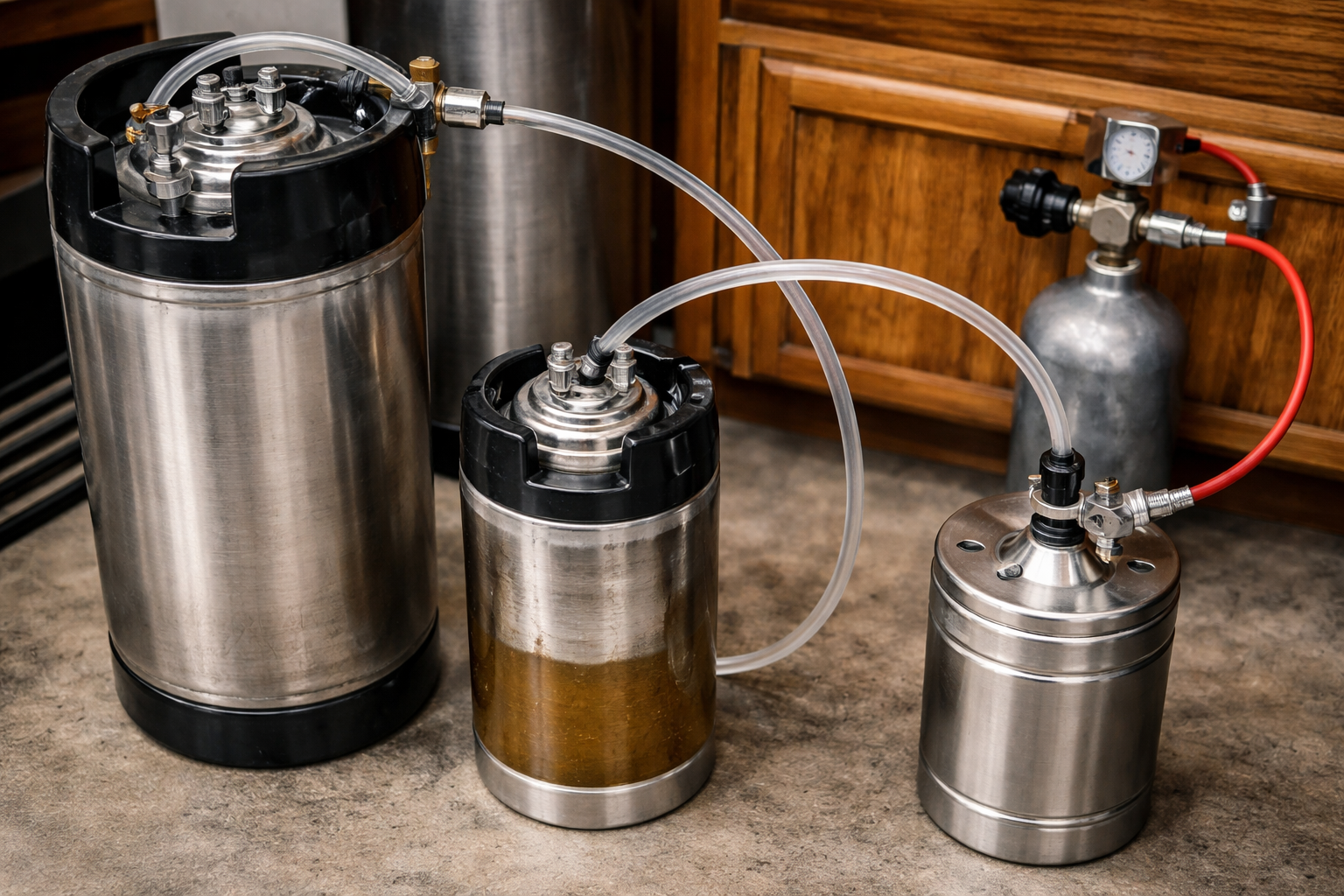
Not every keg day looks like a five-gallon ball lock keg under a neat conical. A few edge cases show up again and again.
Transfer keg to keg when you need to split or rescue beer
Keg-to-keg transfer works well when the receiving keg is purged and kept at slightly lower pressure than the source keg. Connect liquid to liquid, let the source keg push beer across, and vent the receiving keg in a controlled way. Same logic, different starting vessel. Calm fill, controlled vent, stop before liquid reaches the gas side.
Fill a mini keg with the same logic, not the same fittings
Mini keg systems change the hardware more than they change the method. The keg is smaller, the fittings may be different, and vent control can feel touchier. The rules stay the same: sanitize the path, fill from the bottom when possible, vent gas cleanly, and do not overfill.
Work around half-batches and extra headspace
When a batch is small for the keg, headspace becomes more of the story. That does not ruin the beer on its own, but it does make purging more worth the effort. More empty space means more gas to replace. If the beer is sensitive, I would rather use a smaller keg than get casual with a large air pocket.
Be sharper with dry-hopped and hazy beers
These beers punish lazy transfers. Hop matter can clog poppets and dip tubes. Oxygen can flatten the aroma and darken the beer sooner than expected. Cold-crashing, using a floating dip tube when the setup supports it, and keeping the transfer closed all help here.
Package without CO2 when you must, then accept the trade
Yes, you can fill a keg without a CO2 tank. An open gravity transfer still works, and natural conditioning in the keg can carbonate the beer later. What you do not get is a fully closed, low-oxygen process. For some beers that trade is fine. For a fresh IPA, I would not choose it if gas gear was available.
When keg size itself is the problem, this guide to the best beer kegs for home brewing is the right rabbit hole, not another argument with a five-gallon keg that is clearly the wrong fit.
Finish with a one-screen checklist so the process is repeatable
Beer keg fill checklist
Before the transfer
- Keg cleaned, including posts, poppets, and dip tubes
- Keg sanitized and liquid path confirmed open
- Lid and fittings checked for leaks
- Receiving keg purged with CO2 if the setup allows it
- Transfer method matched to the fermenter you actually have
During the transfer
- Beer enters at the bottom of the keg
- Displaced gas has a clean exit path
- Flow stays calm, not blasting or surging
- No splashing, no hose dancing above the liquid line
- Stop before beer reaches the gas side
After the transfer
- Lid seated and headspace purged if the fill was open
- Keg chilled all the way down before judging carbonation
- Carbonation method picked on purpose, not out of impatience
- Foam diagnosed by temperature, pressure, and line setup first
That is really the whole game. Keep the path clean. Match the transfer to the vessel. Fill quietly. Stop in time. Chill before you start blaming pressure. Once that rhythm clicks, keg day gets a lot less dramatic.
If a broader refresher helps, this kegging homebrew guide covers the bigger picture around packaging and first pours.
FAQ
Can you fill a beer keg without a CO2 tank?
Yes. A careful gravity transfer into a sanitized keg still works, and the beer can be naturally conditioned in the keg. What drops away is the low-oxygen benefit of a fully purged, closed transfer.
Should you fill through the open lid or through the liquid post?
If the setup can stay closed, filling through the liquid post is cleaner because the beer enters through the liquid dip tube and rises from the bottom. If the setup is a basic gravity fill, using the open lid with tubing resting at the bottom of the keg is still a solid method.
How much headspace should be left in a Cornelius keg?
There is no single perfect number across every keg. The practical target is enough room for the lid to seat cleanly and for carbonation to behave without beer pushing into the gas side. When foam or liquid starts reaching the vent side during filling, you are at the stop point.