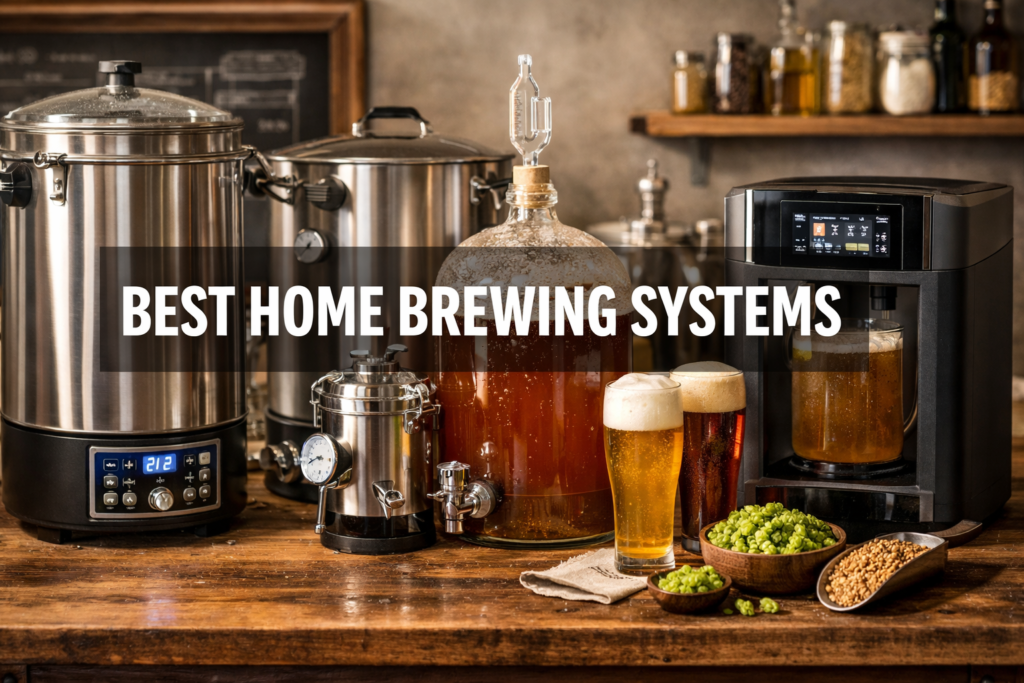
The funny part is that most people who search for the best home brewing systems are not really comparing systems yet. They are comparing hopes. One person wants a clean, repeatable 5-gallon brew day in the kitchen. Another wants a low-risk first batch that will not turn into a pile of tubing, sanitizer, and regret. Another just wants beer without babysitting a stockpot for half a Saturday.
So here is the plain answer up front: for most hobby brewers who know they want to keep brewing, a mid-range all-in-one electric brewer is the best fit. For true beginners, a complete starter kit is usually the smarter buy. That split matters because a starter kit, an all-grain electric setup, and a countertop appliance do not solve the same problem, even if search results treat them like they do.
I have seen this go sideways in very predictable ways. Somebody buys a premium electric unit, then finds out their outlet situation is awkward, their storage space is worse than they thought, and the real weak link in their beer is fermentation temperature. Good gear. Wrong job.
- Which type of home brewing system fits your brew style
- Which 3 products stand out for beginners, value, and premium repeatability
- How to judge batch size, voltage, cleanup, and upgrade path without guessing
- What usually goes wrong after the first few brew days
- Where to put your money first if you care about better beer, not shinier hardware
Best Suggestions Table (All products have been personally reviewed & tested by us! Click the buttons below to jump to the reviews.)
| Product | Best for | Action |
|---|---|---|
| Northern Brewer Brew. Share. Enjoy. Starter Kit | First-time brewers who want a full starter path |
Check Price Review |
| Anvil Foundry 10.5 | Value-focused all-grain brewers who want room to grow |
Check Price Review |
| Grainfather G30 | Frequent brewers who want polished workflow and support |
Check Price Review |
Tip: Clicking the “Review” button will move you to the review so you can decide fast.
Still in doubt? Here’s a fast guideline to save you some time.
- If this is your first batch and you want the least messy learning curve, start with a complete beer brewing kit.
- If you want 5-gallon all-grain batches without building a garage setup, get an all-in-one electric brewing system.
- If you brew only once in a while, lean toward simpler gear. Complexity gets old fast.
- If your beer quality has been shaky, spend part of the budget on fermentation control before chasing a fancier kettle.
- If you have only a standard household outlet, check voltage before you fall in love with a machine.
The best home brewing system for most people, and when that answer changes
For most readers, the sweet spot is an all-in-one brewing system in the middle of the market. Not the cheapest. Not the flagship. Something that can handle 5-gallon all-grain batches, gives you stable temperature control, and does not turn cleanup into a second hobby.
That answer changes fast once your situation changes. A true beginner often gets more value from a complete starter kit because it teaches the process without forcing a big bet. A brewer in a small apartment may care more about footprint and storage than fancy mash programming. A person brewing twice a month may feel every design shortcut and support gap a lot more than the person brewing three times a year.
The first useful split is not “what brand is best?” It is “what kind of system am I actually shopping for?” That is where most roundup posts get mushy. They compare a beginner homebrewing kit with a serious electric all-grain unit like both are just different flavors of the same thing. They are not.
Note: If you want the shortest honest answer, buy a full starter kit for your first few batches or buy a solid all-in-one electric unit if you already know you want the full all-grain process. Skip the weird middle ground where you spend starter-kit money on incomplete gear and still need to piece everything together.
The other wrinkle is beer quality. A shiny brewer feels like the center of the setup, but it often is not. The American Homebrewers Association’s guidance on fermentation temperature control walks through how temperature swings push esters, fusels, and off-flavors around. That is not theory. It is why a modest brew kettle paired with controlled fermentation can beat a premium electric brewer paired with a warm closet.
So yes, there is a best answer. But it only stays best if it matches your batch size, outlet, space, and patience on brew day.
Pick the right system type first, or every comparison gets sloppy
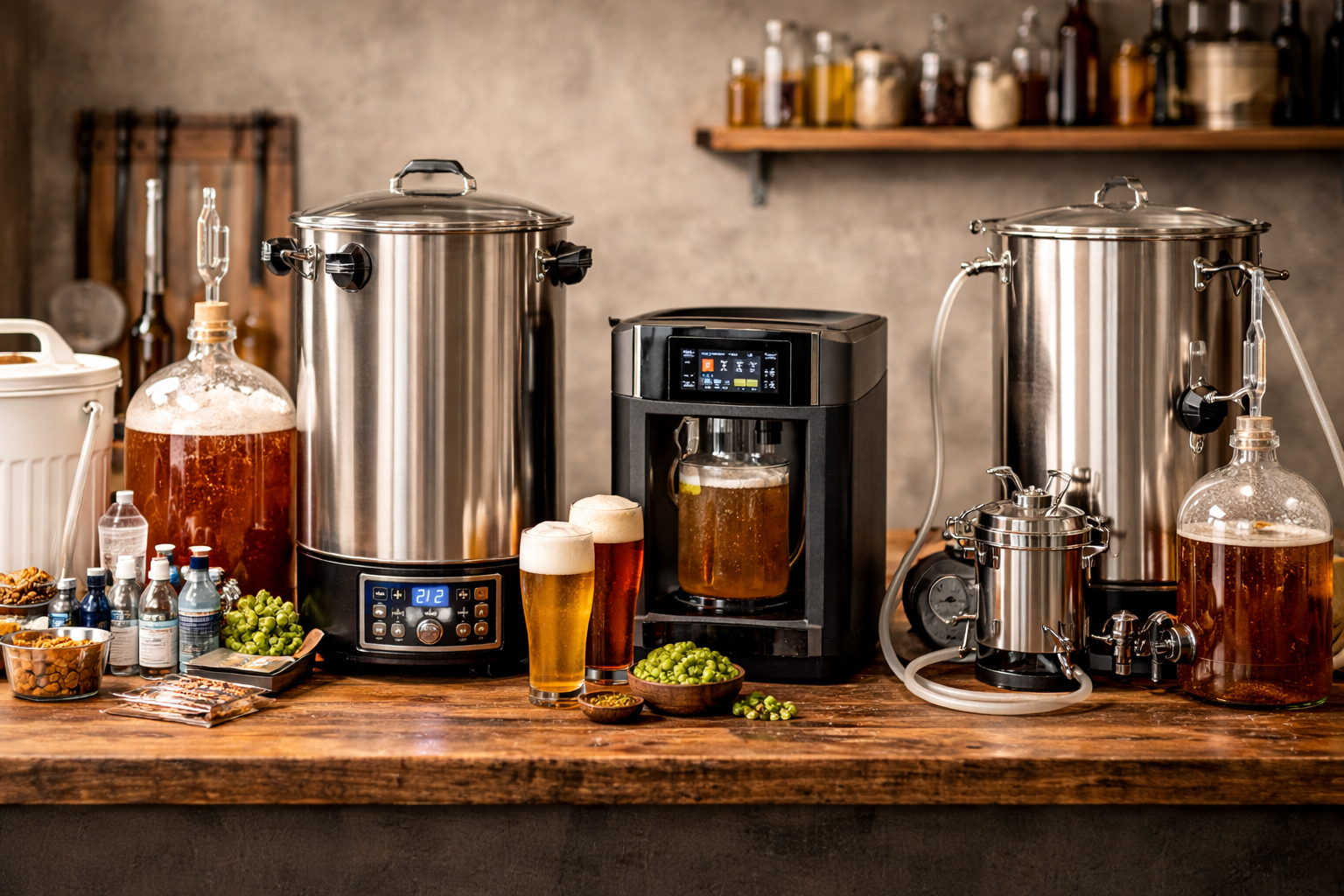
There are four real buckets here. Once you sort them cleanly, shopping gets easier in a hurry.
Starter kits are for learning the process without spending like an enthusiast on day one. These usually lean on extract brewing, simple fermentation gear, and basic packaging tools. Their best trait is completeness. Their weak spot is ceiling. You will outgrow one if you get hooked.
All-in-one electric brewing systems are the default answer for many homebrewers now. They bundle heating, mashing, boiling, and usually some level of pump-driven recirculation into one compact footprint. This is the category most people mean when they search “best home brewing systems.”
Countertop convenience systems aim at ease, not depth. They can make sense for somebody who cares more about quick beer-like results than about recipe control, grain bills, or proper all-grain workflow. I would not put them high on the list for anyone who wants to learn brewing in a durable way.
Modular setups are for brewers who like to build, tweak, and expand. Separate kettle, pump, chiller, and fermentation pieces give you freedom. They also give you more decisions, more hoses, and more places for small annoyances to pile up.
Here is the decision rule I keep coming back to:
- If you want the cheapest path to a real first batch, buy a complete starter kit.
- If you want 5-gallon all-grain brewing without building a mini brewery, buy an all-in-one electric unit.
- If you want full control and like gear projects, build modular.
- If you mostly want a novelty appliance, do not confuse that with a proper brewing setup.
Pro tip: Decide whether you want to learn brewing or mostly automate it. Those are close cousins, not twins.
I have watched people do the category mistake in both directions. One brewer bought a premium all-grain machine and got overwhelmed by the full workflow. Another started with a bare-bones kit, loved the hobby, and then spent more money replacing half the starter gear than they would have spent choosing a better long-term path. The right system type saves money because it saves do-overs.
Use these 6 filters to find your best fit in under 5 minutes
Specs only help once they turn into decisions. These six filters do the heavy lifting.
| Filter | What to check | What it changes |
|---|---|---|
| Batch size | 1 gallon, 2.5 gallon, or 5 gallon target | Ingredient cost, time, storage, and whether small test batches make more sense |
| Brewing method | Extract, brew in a bag, or full all-grain | Complexity, flexibility, and how much process control you get |
| Power | 120V or 240V | Heat-up time and boil strength |
| Space | Storage, sink access, ventilation, lifting room | Whether brew day feels easy or like moving house |
| Cleanup load | Pumps, chillers, hoses, grain basket, trub handling | How often you will actually use the system |
| Upgrade path | Accessories, pump add-ons, recipe flexibility | Whether the system grows with you or gets replaced |
Batch size: 1-gallon brewing is underrated. It is brilliant for test batches, gifts, and people who do not want 50 bottles of something they are not sure they even like. Five gallons is the normal hobbyist sweet spot. Enough beer to make the day feel worth it, but not so much that the whole thing becomes a lifting problem.
Method: extract brewing keeps the barrier low. Brew in a bag, often shortened to BIAB, gives you a simpler path into all-grain brewing. Full all-grain electric systems give you the most repeatability and range, but you pay in cost and cleanup.
Power: this one trips people up. The Anvil Foundry 10.5 is notable because it supports both 120V and 240V operation on its official product page. That matters because a machine that works on standard household power is easier to fit into normal life, while 240V is far nicer if you hate long heat-up waits or weak boils.
Cleanup: this sounds dull until your third brew day. Then it becomes weirdly emotional. Pumps and recirculation are useful. So are grain baskets. But every extra loop in the workflow is another thing to rinse, scrub, dry, or swear at.
Upgrade path: a good all-in-one brewer should not trap you. It should leave room for better chilling, better fermentation, recipe experimentation, and eventually maybe kegging.
If you brew rarely, simpler often wins. If you brew often, better controls and a smoother workflow start to earn their keep.
Best home brewing systems by brewer type, not by random category labels
Before the picks, here is how I judged them. I looked at completeness for the buyer type, practical brew-day workflow, temperature control, power flexibility, cleaning burden, and whether the system stays useful after the honeymoon stage. That last one matters more than people think. Some gear looks exciting on day one and then ends up shoved behind a water heater by batch three.
I also weighed how each system behaves in the real friction points: setup, mash handling, transferring liquid, and cleanup. That is where good equipment earns its reputation.
How we tested them: Each pick was judged against the same brew-day checklist: setup speed, clarity of instructions, how easy it was to hit and hold mash temperature, whether transfer and chilling steps felt fussy or smooth, and how annoying cleanup became once the fun part was over. For the starter kit, the main test was “can a first-time brewer get from box to fermenter without hunting for missing parts?” For the electric systems, the main test was “does this feel repeatable and sane for regular all-grain brewing?”
Northern Brewer Brew. Share. Enjoy. Starter Kit
Best for: true beginners who want a complete beer brewing kit, not a scavenger hunt.
This is the easy pick for first-timers because the value is not just the equipment. It is the completeness and the lower chance of a frustrating first batch. Northern Brewer’s own product page lays out the appeal clearly: it is an all-inclusive kit, it includes a brew kettle, and it is built to get a beginner brewing without patching together missing pieces. That matters. A starter kit fails fast when it leaves out one dumb, practical thing you need the night you finally try to brew.
In use, this kind of kit makes sense because it keeps the moving parts readable. You are learning boil timing, sanitation, fermentation basics, and bottling. You are not also learning how to manage a grain basket, a recirculation pump, electric controls, and a full all-grain workflow all at once. For many people, that slower ramp is not “less serious.” It is just smarter.
Its limits are also clear. You are not buying a long-term all-grain brewing system here. You are buying a clean first step. If you already know you want to brew often and want full all-grain control, you will outgrow this kit. But if your real goal is “I want my first batch to go well and I want to understand what I am doing,” this is a very good answer. I like it most for beginners, gift buyers, and people who want to test the hobby before committing shelf space and a chunk of budget to a larger electric setup.
Anvil Foundry 10.5
Best for: value-focused brewers who want a real all-in-one electric brewing system with room to grow.
The Anvil Foundry 10.5 hits a very attractive middle lane. On the official Blichmann page, the standout detail is the dual-voltage design with 120V and 240V support. That is not marketing fluff. It changes who this system works for. You can start in a normal household setup and still have a better long-term lane if you later move to 240V. That flexibility saves people from one of the dumbest buying mistakes in this category: falling in love with a machine that does not fit the power you actually have.
On brew day, the Foundry feels practical rather than precious. It gives you a proper grain basket, all-grain capability, and a workflow that feels serious without becoming overbuilt. That balance is why it lands so often as the value pick. It is easier to justify than a premium unit if you brew regularly but do not need the most polished ecosystem on the market.
There is still a tradeoff. It is not a “set it and forget it” toy, and it does not hide the brewing process from you. That is a plus for some brewers and a minus for others. I would point a beginner here only if that beginner already knows they want to brew often and are happy to learn the full process. For a brewer upgrading from stovetop or brew in a bag, though, this is one of the best jumps in the category because it improves organization, repeatability, and footprint without forcing a premium-brand leap.
Grainfather G30
Best for: frequent brewers who want a polished premium system and a smoother overall workflow.
The Grainfather G30 earns its reputation on refinement. Grainfather’s official product pages focus on the parts that matter here: PID temperature control, app-guided brewing, an integrated all-in-one design, and the included counterflow chiller. The interesting thing is not any one feature by itself. It is how the whole setup reduces small points of friction that repeat brewers feel every single batch.
That is what premium gear is supposed to do. Not just add features. Remove drag.
The G30 is the pick for the brewer who wants repeatability, solid recipe support, and a setup that feels thought through. The included counterflow chiller is a good example. Chilling is easy to under-rate when shopping because it is not flashy. Then you brew on a mediocre setup and remember, right, this part matters. Faster, cleaner chilling and a smoother overall flow make the day feel less cobbled together.
The caution is simple. This is not the right machine if you only brew once in a blue moon or if you are still not sure the hobby will stick. It makes more sense for somebody who brews often enough to appreciate the polish. If that is you, the G30 is one of the clearest premium picks because it is not premium in a vague way. It is premium where repeat brewers actually notice it: control, workflow, support, and the feeling that the whole system was designed by people who know where home brew days get messy.
Compare the tradeoffs that actually matter on brew day
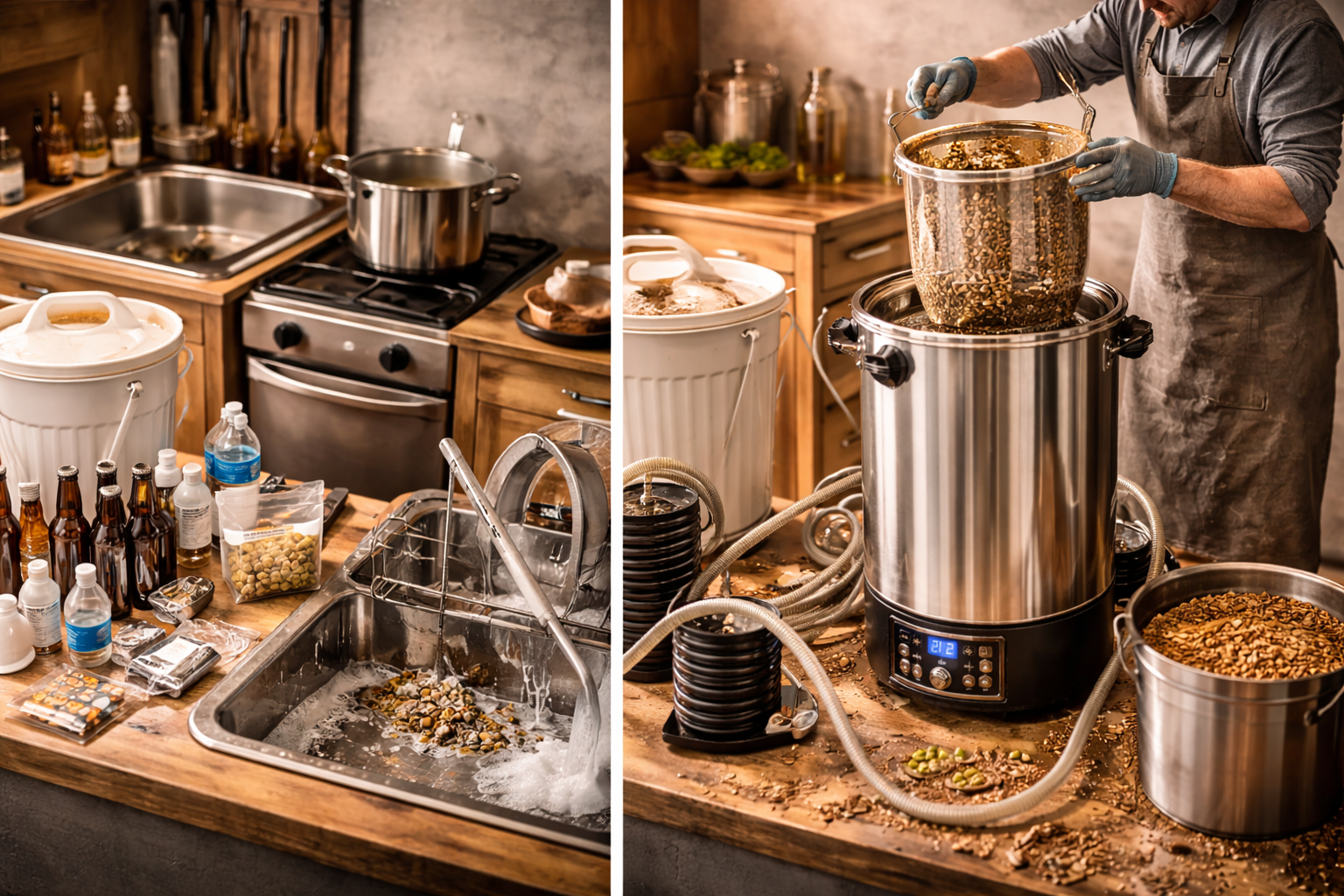
The easiest way to ruin a buying decision is to shop by abstract feature count. Brew day is much less glamorous. It is lifting, draining, waiting, cleaning, and trying not to drip sugary wort across the kitchen floor.
| Tradeoff | Starter kit | All-in-one electric | What that means for you |
|---|---|---|---|
| Setup time | Lower | Moderate | Starter kits get you brewing fast. Electric systems repay the extra setup over repeated batches. |
| Control | Basic | Much higher | If recipe flexibility matters, all-in-one wins by a lot. |
| Cleanup | Usually simpler | More parts to wash | If you hate cleanup, do not buy complexity just because it looks advanced. |
| Repeatability | Fair | Better | Electric systems help more once you brew often enough to care about consistency. |
| Space | Flexible | Needs planning | Big gear in a cramped kitchen gets old fast. |
A few real-world rules make this easier.
If cleanup is the part you secretly dread, bias toward simpler gear. Many brewers talk themselves into pumps, recirculation, extra valves, and integrated everything. Then they discover that the annoying part was never the mash. It was the forty minutes after the mash.
If waiting for water to heat drives you nuts, take voltage seriously. This is where a 240V-capable system starts to feel less like a spec-sheet detail and more like a quality-of-life upgrade.
If small-space brewing is the reality, do not buy for your ideal future garage. Buy for the sink, counter, and storage you actually have now. Buying a big all-grain rig for occasional tiny curiosity batches is like buying stiff hiking boots to walk to the corner shop. Technically possible. Also faintly ridiculous.
Important: Convenience is not the same thing as automation. For many brewers, “convenient” just means fewer annoying steps and less cleanup.
Avoid the 7 buying mistakes that make good systems feel disappointing
1. Ignoring fermentation temperature control. This is the big one. Brewing gets the attention because it is fun to shop for. Fermentation gets ignored because it is less photogenic. That is backwards. If your fermentation swings warm or erratic, the brewer itself will not save the batch.
2. Buying too much batch size. Five gallons is not just “a little more” than a small batch. It changes lifting, cleanup, storage, and what happens if the beer turns out just okay. A lot of first-timers do better with smaller volumes than they expect.
3. Taking “automatic” too literally. Even the friendliest electric brewing system still wants your attention. Grain bills, water chemistry, sanitation, chilling, yeast handling, and packaging still matter. The machine smooths the process. It does not brew with common sense on your behalf.
4. Under-rating cleanup and sanitation. This one sneaks up on people. The glamorous shopping phase makes every extra accessory feel exciting. Then brew day ends and the sink fills up. That is where bad habits start. And bad habits here hurt beer quality fast.
5. Forgetting the outlet. It sounds obvious. It somehow is not. Check your power before you buy.
6. Buying a “system” that is not actually a full setup. Some people need a brewer. Some people need a whole path from boiling to fermentation to bottling. Those are different shopping lists.
7. Spending the budget on the hot side and neglecting the rest. A better brew kettle is fun. A better fermentation setup is often the thing that makes the beer taste cleaner and more repeatable.
There is also a basic safety and legality point worth saying plainly. Brewing beer at home is one thing. Distilling spirits at home is another. The U.S. Alcohol and Tobacco Tax and Trade Bureau is very clear that home distilling is illegal without federal permits, even when beer and wine production are allowed for personal use. The agency spells that out on its home distilling guidance. For this article, we are talking about beer brewing systems, not stills and not workarounds.
Spend your money in the right order for better beer, not just shinier gear
A sensible budget ladder clears up a lot of confusion.
Under the starter range: buy a complete kit and keep the first goal small. Finish a batch. Learn sanitation. Learn fermentation. Get through bottling once. A cheap, incomplete setup that still forces you to buy missing parts is usually worse value than a fuller beginner package.
Mid-range: this is where all-in-one electric brewing systems start to make the most sense. You get the compact footprint, the cleaner workflow, and the repeatability that turns regular brewing into a habit rather than an event.
Premium: pay for polish, support, and a smoother brew day. Do not pay extra just because a control panel looks fancy. The right premium features are the ones you notice every batch: stable control, better chilling, cleaner transfers, clearer setup, and a stronger product ecosystem.
One of the sharper buying truths here is a little annoying because it pushes against gear lust: if the budget is tight, leave room for fermentation control before you chase a fancier kettle. That may mean a temperature-controlled fridge or a simpler setup that keeps yeast in a better range. It is not the sexy answer. It is often the right one.
Note: The best home brewing systems help a lot with process flow. They do not replace discipline on sanitation, yeast health, and fermentation.
And that is the part many shopping guides never quite say out loud. Past a certain point, extra money buys comfort and refinement more than radically better beer. That can be worth it. It is just worth it for a different reason.
Make the final choice with this simple shortlist framework
If you are still deciding, do this in order and stop the moment one answer becomes obvious.
Step 1. Choose the system type that matches your stage.
Brand-new brewers should start with a complete beginner path. Regular brewers who want all-grain should look at all-in-one electric units first.
Step 2. Set the batch size you will actually enjoy making.
If you like experimenting and hate waste, start smaller. If you want a normal hobby setup with a better yield-to-effort ratio, 5 gallons is still the practical center.
Step 3. Confirm your power and space before you compare features.
This keeps you from shopping inside a fantasy garage that does not exist.
Step 4. Check what is included.
Some buyers need only the brewer. Others need fermenter, bottling gear, and the basic tools that make batch one possible.
Step 5. Pick your bias: simplicity or expandability.
There is no prize for buying more complexity than you want to live with.
That leaves most readers in one of three lanes.
- “I am brand new and want the least risky start.” Get the Northern Brewer Brew. Share. Enjoy. Starter Kit.
- “I brew or plan to brew often and want good value in all-grain.” Get the Anvil Foundry 10.5.
- “I want premium polish and I know I will use it.” Get the Grainfather G30.
That is the shortlist. Short for a reason.
You do not need ten shaky options. You need the one that fits how you will really brew.
FAQ
Is a 120V brewing system enough for 5-gallon batches?
Yes, for many brewers it is. The tradeoff is time. Heat-up and boil performance are usually better on 240V, so if faster brew days matter a lot, that is where the upgrade pays off.
What is better for a beginner: extract or all-grain?
Extract is usually the smoother first step because it cuts down the moving parts. All-grain makes more sense once you know you enjoy the hobby and want more recipe control.
Do I need a wort chiller right away?
Not always. Many starter paths work without one. For regular all-grain brewing, though, better chilling starts to matter because it helps the whole workflow feel cleaner and less improvised.