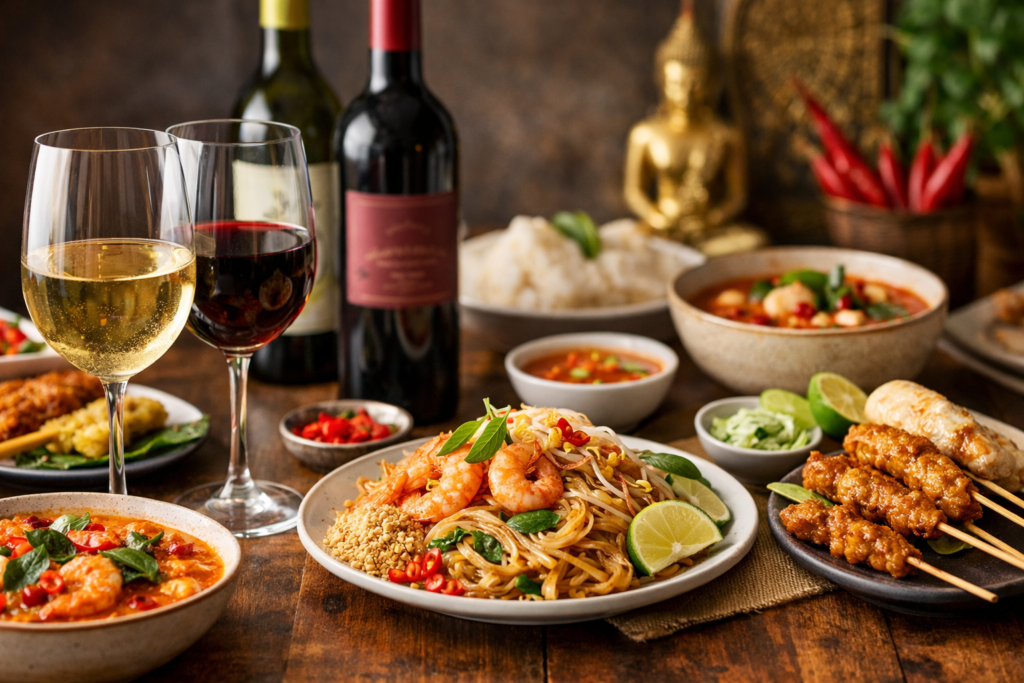
I’ve watched this go wrong in a very normal way. You grab a bottle that feels “nice”, the takeout bags hit the table, someone opens the green curry, someone else tears into pad Thai, and the first sip suddenly tastes hotter, flatter, or weirdly bitter than it did five minutes earlier.
If you’re trying to pick the best wine for Thai food, the safest answer is usually off-dry Riesling. Good backups are Chenin Blanc, Pinot Gris, Gewurztraminer, Sauvignon Blanc, Gruner Veltliner, dry rose, and Brut sparkling wine. For milder, meatier, or grilled dishes, Pinot Noir or Gamay can work too. That short list holds up because, as WSET’s guide to pairing drinks with spice explains, chilli makes alcohol feel hotter, tannin feel harsher, and a touch of sweetness can calm the heat.
The catch is that Thai food is not one flavor. A limey tom yum wants something different from a coconut-rich massaman. A herb-loaded larb behaves differently from a sweet-savory pad Thai. So the useful rule is this: pair to the loudest thing on the plate, not the protein named on the menu.
What you’ll get from this guide
- the safest overall wines for Thai takeout and mixed tables
- when dry beats off-dry and when that goes sideways
- which wines fit green curry, pad Thai, tom yum, som tam, and pad see ew
- when red wine actually works
- which bottles usually miss and why
At a glance: the fast pick
| If the meal looks like… | Start here | Smart backup |
|---|---|---|
| spicy, sweet-sour, mixed takeout | off-dry Riesling | Brut sparkling |
| green, herbal, limey dishes | Sauvignon Blanc | Gruner Veltliner |
| coconut curry or richer noodles | Chenin Blanc | Pinot Gris |
| milder grilled or beefy dishes | Pinot Noir | Gamay |
A mixed Thai table rewards freshness, acidity, and a bit of give. Muscle wine usually loses.
Note: Wine pairing is about taste, not health. The CDC notes that even moderate drinking can raise health risks. If you already drink, keep the pour sensible.
The best wine for Thai food in one clear answer
If the menu is broad and you only want one bottle, buy off-dry Riesling. It handles chilli better than most wines, keeps up with lime and tamarind, and still feels fresh next to herbs, fish sauce, and sweet-savory sauces. I’ve leaned on it for the classic “two curries, one noodle dish, one salad, and nobody agreed on heat level” dinner more than once. It is the least stressful answer for a reason.
If Riesling is not your thing, use this short list instead:
| Style | Best for | Watch out for |
|---|---|---|
| Off-dry Riesling | mixed menus, spicy dishes, sweet-sour sauces | bone-dry versions if the food is hot |
| Sauvignon Blanc | green curry, tom yum, limey and herbal dishes | very sharp styles with sweet sauces |
| Chenin Blanc | coconut curry, richer noodles, peanut sauces | heavy oak |
| Pinot Gris or Gewurztraminer | aromatic dishes, moderate heat | cloying, floppy sweet versions |
| Dry rose or Brut sparkling | fried starters, mixed tables, easy crowd-pleasing | thick, high-alcohol rose |
| Pinot Noir or Gamay | milder grilled dishes, duck, beef, soy-caramelized noodles | high heat, heavy oak, chunky tannin |
The quick decision rule: if the table looks spicy or unpredictable, go off-dry Riesling. If it looks greener and sharper, lean Sauvignon Blanc or Gruner Veltliner. If it looks richer and creamier from coconut milk, reach for Chenin Blanc. If the heat is dialed down and the food leans grilled or beefy, that is when Pinot Noir or Gamay gets a seat.
Why Thai food changes the pairing rules
Thai food is not hard to pair because it is spicy. It is hard to pair because it stacks flavors. Lime, fish sauce, palm sugar, tamarind, herbs, chilli, char, and coconut can all show up in one meal, and sometimes in one bite.
That balance is baked into the cuisine. In its piece on fish sauce and classic Thai condiments, the Thailand Foundation shows how Thai sauces often pull together salty, sweet, sour, and spicy elements at once. That is why protein-first pairing goes off course so often. “Chicken curry” tells you less than “green, herbal, hot, and coconut-rich chicken curry.”
That same WSET spice pairing guide lays out the part people feel in the glass but cannot always explain: alcohol feels hotter next to chilli, tannin feels rougher, and a little sweetness can soften the burn. WSET’s broader piece on food and wine matching adds the rest of the map. Salt, sugar, acidity, fat, and chilli all change how the wine tastes. You are not just matching flavors. You are managing collisions.
So here is the usable framework.
The 5-second Thai pairing filter
- Check the heat. More chilli usually means lower alcohol and a touch more sweetness.
- Check the brightness. More lime, tamarind, or green herbs means you want brisk acidity.
- Check the richness. Coconut milk, peanuts, and richer stir-fries can handle a fuller white.
- Check the char. Grilled meat and soy-driven dishes open the door to light reds.
- Check the sweet-savory pull. Pad Thai, sweet chilli sauces, and some salads punish very austere dry wines.
Think of it like clothing for weather. A stern Cabernet with a hot green curry is a wool coat in a steam room. It is not “wrong” on paper because red can go with meat. It is wrong because the conditions changed.
This same sauce-first habit shows up in other herb-heavy, high-acid cuisines too. The logic behind wine with Vietnamese food is close cousins with Thai pairing: herbs, acidity, condiments, and texture usually matter more than the headline protein.
The white wines that miss least often
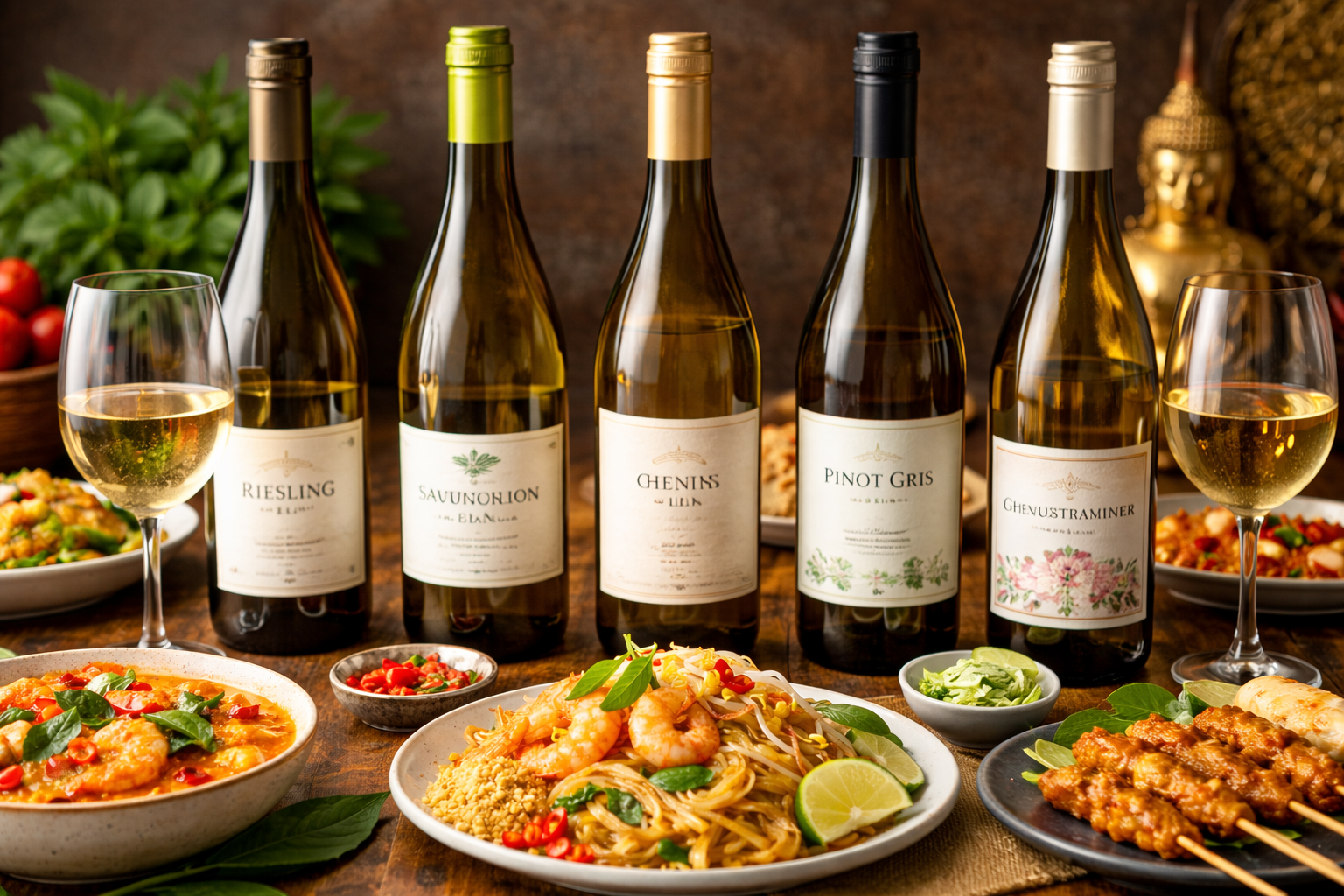
White wine does most of the heavy lifting here. Not because red can’t work, but because white has an easier time staying fresh when a dish swings between chilli, lime, fish sauce, sugar, and herbs.
Off-dry Riesling
This is still the gold-standard safety pick. You get acidity, floral lift, and that small cushion of sweetness that takes the sting out of chilli. With pad Thai, spicy basil dishes, Thai fried rice, som tam, or a mixed spread of takeout boxes, it is the bottle I’d trust blind.
The trap is assuming every Riesling behaves the same. A dry, stony Riesling can be brilliant with tom yum or a lighter herbal dish, but if the food turns hot and sweet-savory, that bone-dry edge can feel almost mean. Off-dry is the safer lane when you do not know the table.
Sauvignon Blanc and Gruner Veltliner
Pick these when the meal smells green before it tastes spicy. Green curry, larb packed with herbs, tom yum, and anything heavy on lime, lemongrass, or fresh chilli often lights up with these styles. Sauvignon Blanc brings snap. Gruner Veltliner brings peppery freshness and a little more calm.
What they do not love is obvious sweetness. Put a razor-sharp Sauvignon Blanc next to a sweeter pad Thai and the wine can come off a bit hard. You want brightness here, not a lemon wedge with attitude.
Chenin Blanc
Chenin Blanc is the white I reach for when the table is richer than it is fiery. Coconut curries, satay-like peanut notes, pad see ew, and creamier noodle dishes all feel easier with it. Chenin can keep its edge, but it often has more mid-palate shape than Sauvignon Blanc.
That extra body matters. Thai food is not all acid and herbs. A massaman curry or a richer yellow curry wants a wine with some shoulders.
Pinot Gris and Gewurztraminer
These are your aromatic pressure valves. When the dish is perfumed, spicy, or slightly sweet, they can be terrific. Gewurztraminer, in particular, has enough perfume to meet strong aromatics without vanishing. Pinot Gris is a little more restrained and, honestly, easier for more people to love at the table.
Still, this is where shopping gets messy. Cheap sweet versions can feel gummy fast. Look for freshness, not syrup.
If you don’t like Riesling: go Chenin Blanc for richer coconut and noodle dishes, or go Sauvignon Blanc and Gruner Veltliner for greener, sharper, more herbal plates.
When rose, sparkling, and light reds make more sense than another white
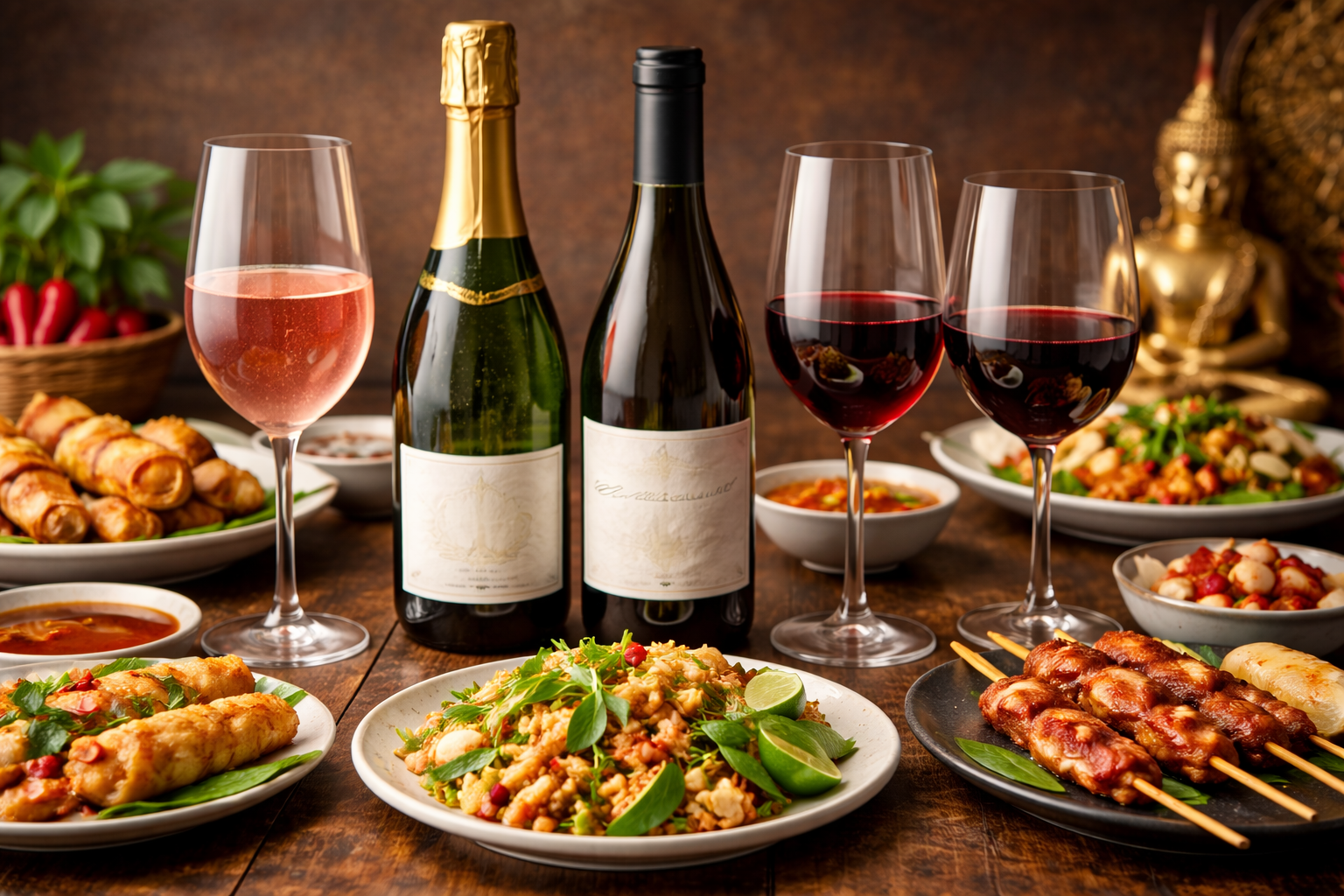
There are nights when another white feels too obvious. Fair enough. Thai food gives you a few side doors, and some of them are excellent.
Dry rose for broad flexibility
Dry rose is sneaky good with Thai food. It has the chill and freshness of white wine, but a little more fruit and shape. That makes it useful with grilled chicken, larb, fish cakes, spicy noodles, and mixed starters where one person ordered spring rolls, another ordered red curry, and nobody planned the bottle.
Keep it light and crisp. A fat, boozy rose is rarely the move here.
Brut sparkling for fried food and mixed tables
Brut sparkling wine is one of the safest “I need this to work with half the menu” answers. Bubbles scrub fried food nicely. High acidity keeps fish cakes, prawn toast, spring rolls, and salty snacks from getting heavy. And if the table has a bit of chilli scattered around, sparkling usually suffers less than a big red.
If you are ordering by the glass and the list is not great, good Brut is often the cleanest escape hatch.
Pinot Noir and Gamay for the right red-wine lane
Yes, red wine with Thai food can work. It just has a narrower lane. Pinot Noir and Gamay are the usual winners because they keep tannin modest and fruit fresh. They work best when the dish is grilled, soy-driven, duck-heavy, beefy, or a little smoky.
Think duck red curry with moderate heat, beef skewers, larb with toasted rice and herbs, or pad see ew with char and dark soy. Think less “fiery jungle curry” and more “savory, a little sweet, a little charred.”
Serve it a bit cooler
Crisp whites and sparkling usually show best around 45 to 50 F (7 to 10 C). Light reds such as Pinot Noir and Gamay often behave better around 55 to 60 F (13 to 16 C). Too warm and the alcohol pokes out fast next to chilli.
Match the bottle to the Thai dish in front of you
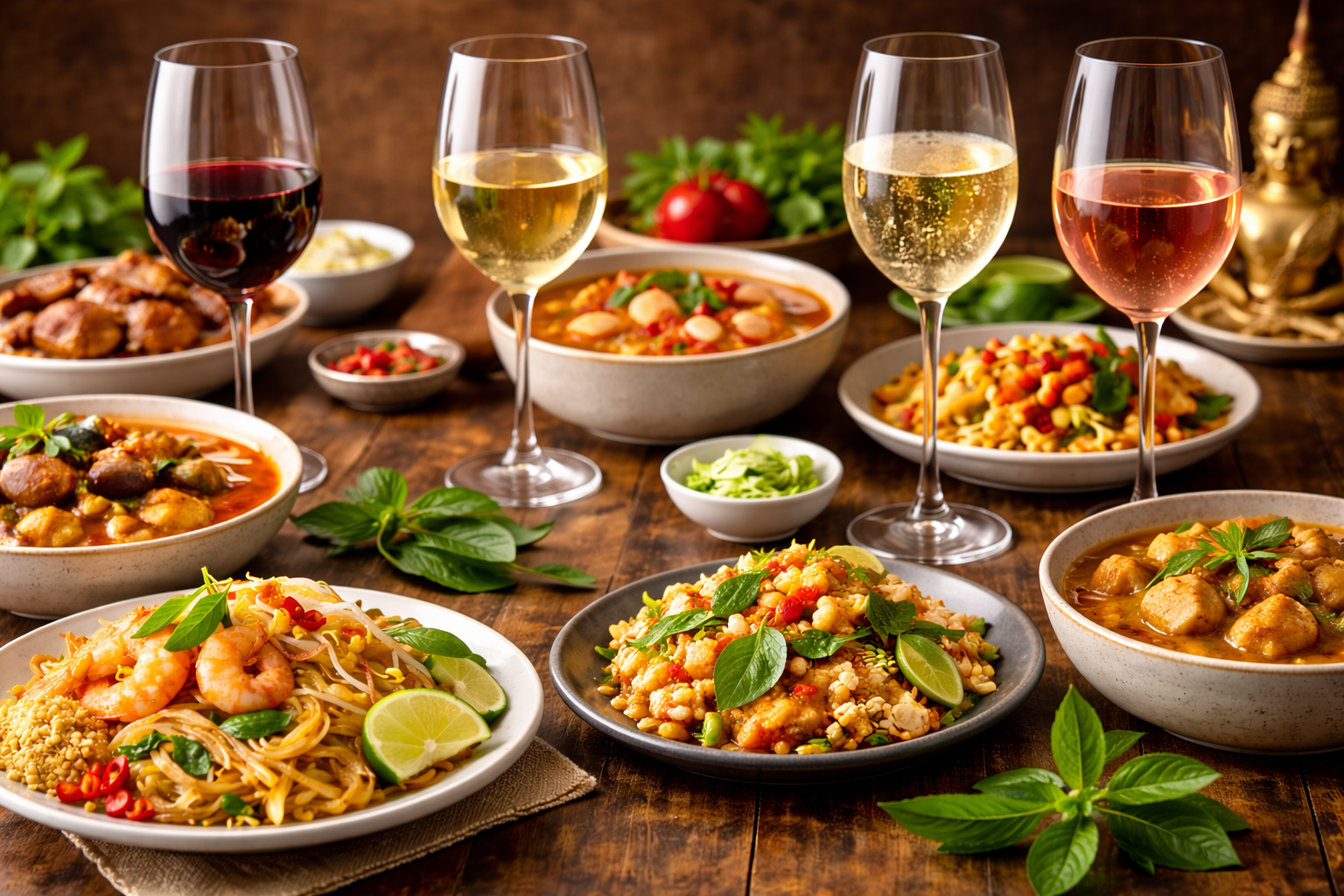
The fastest way to stop overthinking this is to match the wine to the actual dish, not the cuisine label. Here is the cheat sheet I’d want on my phone standing in front of a wine shelf.
| Dish | Best first pick | Good backup | Why it works |
|---|---|---|---|
| Pad Thai | Off-dry Riesling | Chenin Blanc | tamarind, peanuts, sweet-savory sauce, lime |
| Green curry | Sauvignon Blanc | Off-dry Riesling | green herbs, lime, chilli, coconut |
| Red curry with duck or beef | Pinot Noir | Off-dry Riesling | savory depth, richer meat, moderate spice |
| Tom yum | Sauvignon Blanc | Dry Riesling | lime, lemongrass, brothy brightness |
| Som tam | Off-dry Riesling | Light sparkling wine | sweet, sour, salty, hot all at once |
| Pad see ew | Chenin Blanc | Gamay | dark soy, char, richer noodle texture |
| Larb | Dry rose | Gamay | herbs, lime, toasted rice, savory bite |
| Massaman curry | Chenin Blanc | Pinot Gris | coconut, spice, richer body, warming sweetness |
A couple of these calls surprise people. Pad Thai is the obvious one. People see noodles and shrimp and think neutral white. Then the tamarind, peanuts, lime, and sugar make that sharp dry white taste tougher than it should. Off-dry Riesling just behaves better.
Tom yum goes the other way. It is bright, sour, and brothy. That is where a drier, racier wine can shine. Sauvignon Blanc is often a better fit here than a softer, sweeter white.
And massaman? That is your reminder that Thai curry is not one category. Massaman is warmer, deeper, and richer than green curry. It wants shape more than sting control.
Choose one bottle fast for Thai takeout, dinner parties, and mixed tables
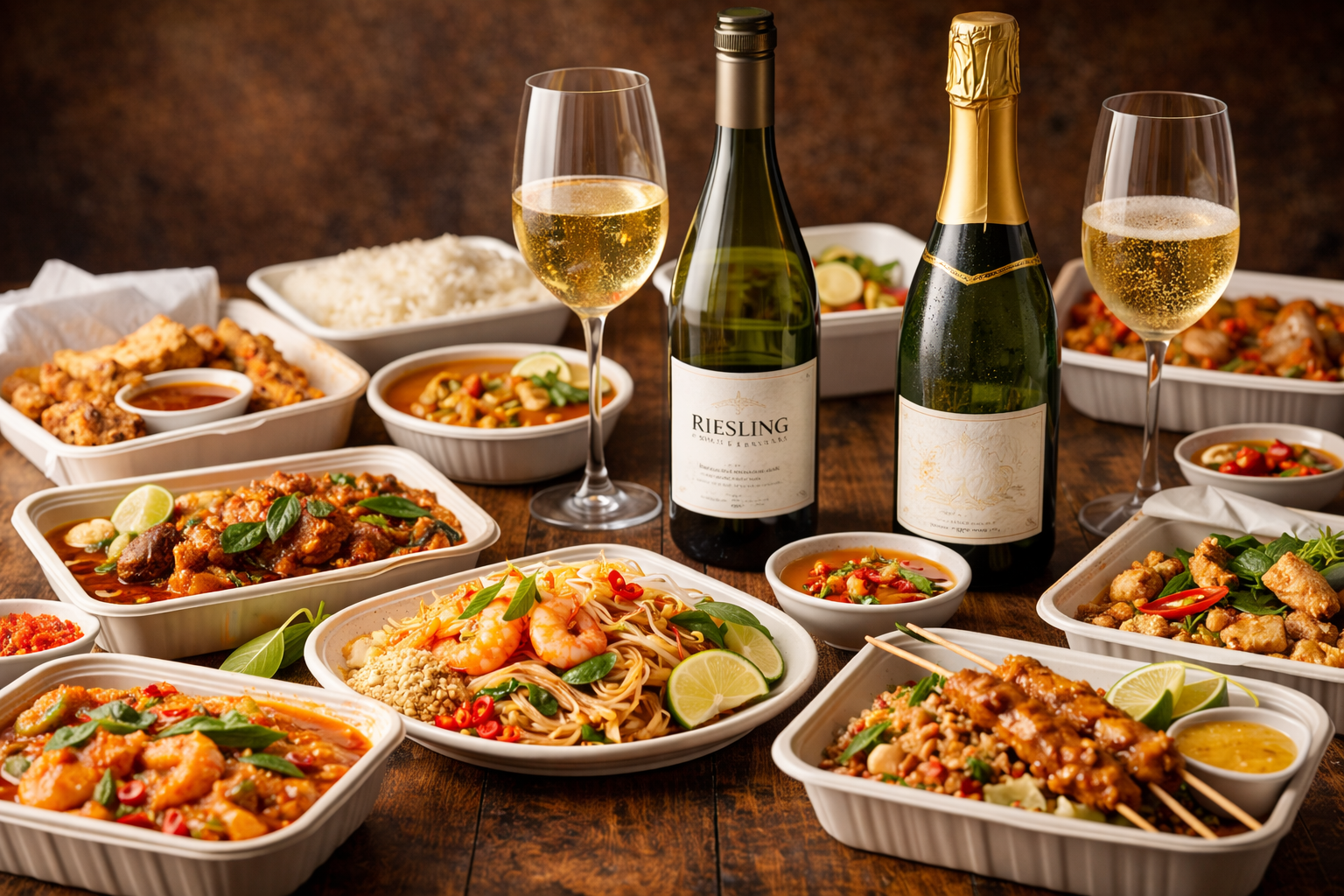
Most people are not pairing for one perfect dish. They are pairing for a table full of containers, or a dinner party where the heat level is half mystery and half ego. For that job, use a short filter and move on.
Step 1. Check the heat and lower the risk
If the meal is likely hot, lower alcohol and lean toward off-dry or sparkling. This is where off-dry Riesling earns its keep. It is forgiving. Brut sparkling works too if the table has more fried starters, lighter curries, or a bunch of share plates.
Step 2. Check whether the table is green and sharp or rich and creamy
If the dishes lean herbal, limey, and bright, go Sauvignon Blanc or Gruner Veltliner. If they lean coconut-rich, peanutty, or noodle-heavy, Chenin Blanc is often the better one-bottle move.
Step 3. Decide if you need one bottle or two
If it is one bottle, buy flexibility. Off-dry Riesling is still the best call. If it is two bottles, split the job. A very good pairing set for Thai food is off-dry Riesling plus Brut sparkling. For a milder, meatier spread, Sauvignon Blanc plus Pinot Noir works nicely.
Label clues that help in the shop
- Good signs: off-dry, Kabinett, Feinherb, demi-sec, Brut, low alcohol, cool climate
- Proceed with care: reserve, heavily oaked, full-bodied, jammy, bold, high alcohol
If the list in front of you is lousy or tiny, sparkling is often the neatest escape route. It is the same reason wine with tacos often rewards bright, flexible bottles over serious, chewy reds. Mixed tables with chilli, acid, toppings, and crunch are asking for freshness first.
One more shopping note, because this trips people up. “Riesling” on the label does not tell you sweetness by itself. German words like Kabinett or Feinherb can be useful clues. If you cannot decode the label fast, ask for something with a little residual sugar and bright acidity. Most good wine shops know exactly what that means.
The wines that usually fail with Thai food
Some wines miss so often that it is easier to rule them out before you start. This does not mean they are bad wines. It means the matchup is asking them to do the wrong job.
Big tannic reds
Cabernet Sauvignon, young Nebbiolo, and other firm, grippy reds often turn rough next to chilli. You feel the tannin more. The fruit feels less generous. The whole pairing gets sandpapery. That is the exact clash WSET warns about when spice meets tannin.
High-alcohol wines
Whether red or white, a hot-feeling wine gets hotter next to chilli. This is why some broad-shouldered Shiraz, powerful Zinfandel, or very ripe Chardonnay styles feel clumsy with Thai food. You do not need a bottle that throws elbows.
Heavily oaked whites
Oak can work with creamy sauces in other cuisines. Thai food is less forgiving. Next to lemongrass, basil, lime, and fish sauce, heavy vanilla and toast can taste blunt or just out of tune. An oaky Chardonnay beside som tam is a rough scene.
Very austere dry whites with sweet-savory dishes
This is the quieter mistake. A severe, bone-dry white beside pad Thai or sweet chilli sauce can make the wine feel sharp and the food feel sweeter than it is. The dish is not bad. The balance just tipped.
Dessert-level sweet wine with savory mains
A little sweetness can help. A lot can feel sticky. Save the properly sweet stuff for dessert or a very narrow pairing. Thai mains usually want freshness with some give, not syrup.
Remember: not every Thai dish is fiery. The milder, smokier, and more savory the plate gets, the more room you have for dry rose and light red wine.
FAQ
Can Chardonnay work with Thai food?
Yes, but only in a narrow lane. A fresher, less oaky Chardonnay can work with richer coconut curries or milder peanut-driven dishes. Heavily oaked Chardonnay usually struggles with lime, herbs, fish sauce, and chilli.
Should light red wine be chilled with Thai food?
A little, yes. Pinot Noir and Gamay often taste cleaner around 55 to 60 F (13 to 16 C). That slight chill keeps the alcohol from sticking out and helps the fruit stay fresh next to spicy or savory dishes.
What wine goes with mango sticky rice?
Moscato d’Asti is a friendly pick because it is light, aromatic, and sweet enough for dessert. Late-harvest Riesling can work too. The rule with dessert still holds: the wine should be at least as sweet as the dish.