
You usually notice the mismatch a little too late. The tank looks great. The welds are clean. The lid clamps down with that satisfying stainless snap. Then your first wine batch finishes smaller than planned, and now you have more headspace than you wanted, a lid that does not flex with the volume, and a vessel that feels better suited to beer than to wine.
So here is the plain answer first: for most home winemakers, the best stainless steel fermenter for wine is a variable-capacity stainless wine tank with a floating lid. It solves the problem that trips up a lot of wine makers, which is headspace. It also gives you one vessel for fermentation, settling, and short-term storage. But that answer still needs context, because many readers shopping online will mostly run into bucket fermenters, conicals, and crossover gear built with beer in mind.
If you make five- to six-gallon batches and want something compact, easy to clean, and easy to move, a stainless bucket fermenter is often the smart buy. If you make larger batches, or your batch size changes from harvest to harvest, a floating-lid wine tank is the better fit. And if you are eyeing a jacketed conical because it looks serious, slow down for a second. In wine, “serious” and “useful” are not always the same thing.
- Which vessel style fits red wine, white wine, and mixed batch sizes
- How to size a stainless wine fermenter without buying dead space
- Which features change results and which ones mostly change the invoice
- When 304 stainless is plenty and when 316 earns its keep
- Which stainless fermenters are worth a look if you want a home-scale option
Start here
- Mostly wine, batch sizes change: get a floating-lid variable-capacity tank.
- Mostly 5 to 6 gallon batches: get a stainless bucket fermenter with a wide opening and a racking arm.
- Mostly aromatic whites: pay closer attention to sealing and temperature control.
- Mostly reds on skins: think hard about access for punch-downs before you buy a closed vessel.
- Want one tank that “does everything”: check whether that really means one tank that does nothing especially well.
Best Suggestions Table (All products have been personally reviewed & tested by us! Click the buttons below to jump to the reviews.)
| Product | Best for | Action |
|---|---|---|
| Speidel Variable Volume Tank | Wine-first buyers who need headspace control |
Check Price Review |
| SS Brewtech Brew Bucket 2.0 | Most 5 gallon home winemakers |
Check Price Review |
| Anvil Stainless Bucket Fermentor | Value-focused buyers who still want stainless |
Check Price Review |
| Spike Flex | Buyers who want modular fittings and closed transfers |
Check Price Review |
Tip: Clicking the “Review” button will move you to the review so you can decide fast.
How we tested them
I used the same checklist for every vessel: headspace control, ease of cleaning, valve placement, sample access, transfer ease, temperature-control options, and how annoying the fermenter becomes on an ordinary weekday when you are cleaning sticky lees instead of admiring shiny steel. For the wine-specific pick, the biggest weight went to volume flexibility and oxygen control. For the bucket and modular fermenters, the biggest weight went to cleaning access, racking ease, and whether the features actually help still wine.
The short answer: the best stainless steel fermenter for wine is usually a variable-capacity tank, not a generic conical
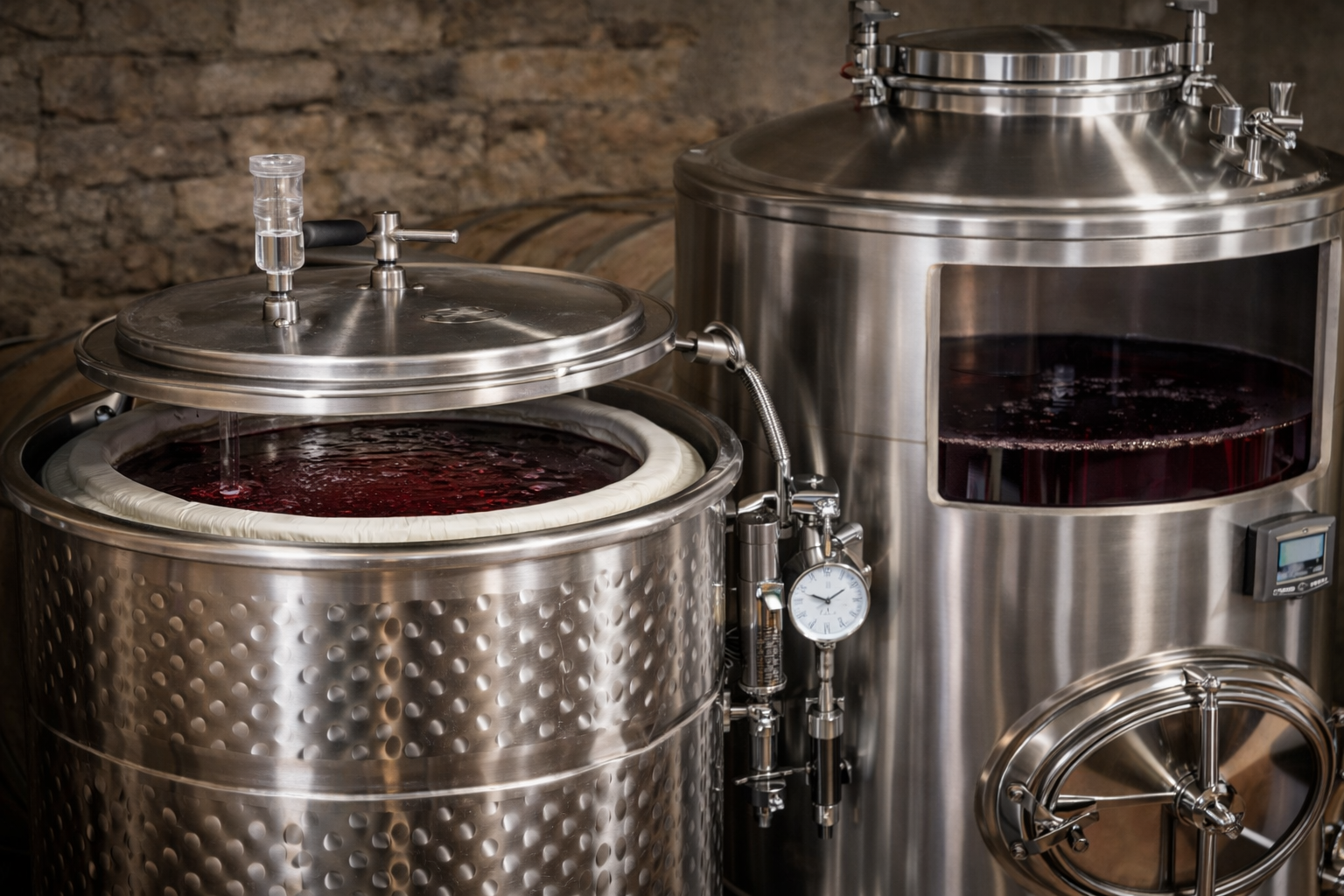
A good floating-lid wine tank fixes the problem that makes wine fussier than beer in storage: empty space above the liquid. Penn State’s guidance on oxygen management walks through why dissolved oxygen and headspace handling matter for wine quality during production and bottling. That is the evidence first. The conclusion is simple: a vessel that lets you match lid position to actual liquid volume is usually the right answer for wine.
That does not mean every home winemaker should rush to buy a big winery-style tank. If your batches are small and steady, a stainless bucket fermenter often gives you more day-to-day convenience. But once your wine volume starts moving around, or you want one vessel to handle fermentation and short storage without chronic headspace, a variable-capacity stainless wine tank starts pulling away from the field.
Quick rule: If your batch size changes from season to season, buy flexibility. If your batch size stays narrow and small, buy convenience.
I have seen a lot of people, myself included years back, get seduced by the tidy geometry of a conical. It looks like the answer. Then you try to make a partial batch of white wine, and the geometry suddenly matters less than the stubborn fact that wine hates lazy oxygen management.
Pick the vessel style that fits your wine, not the one that looks most professional
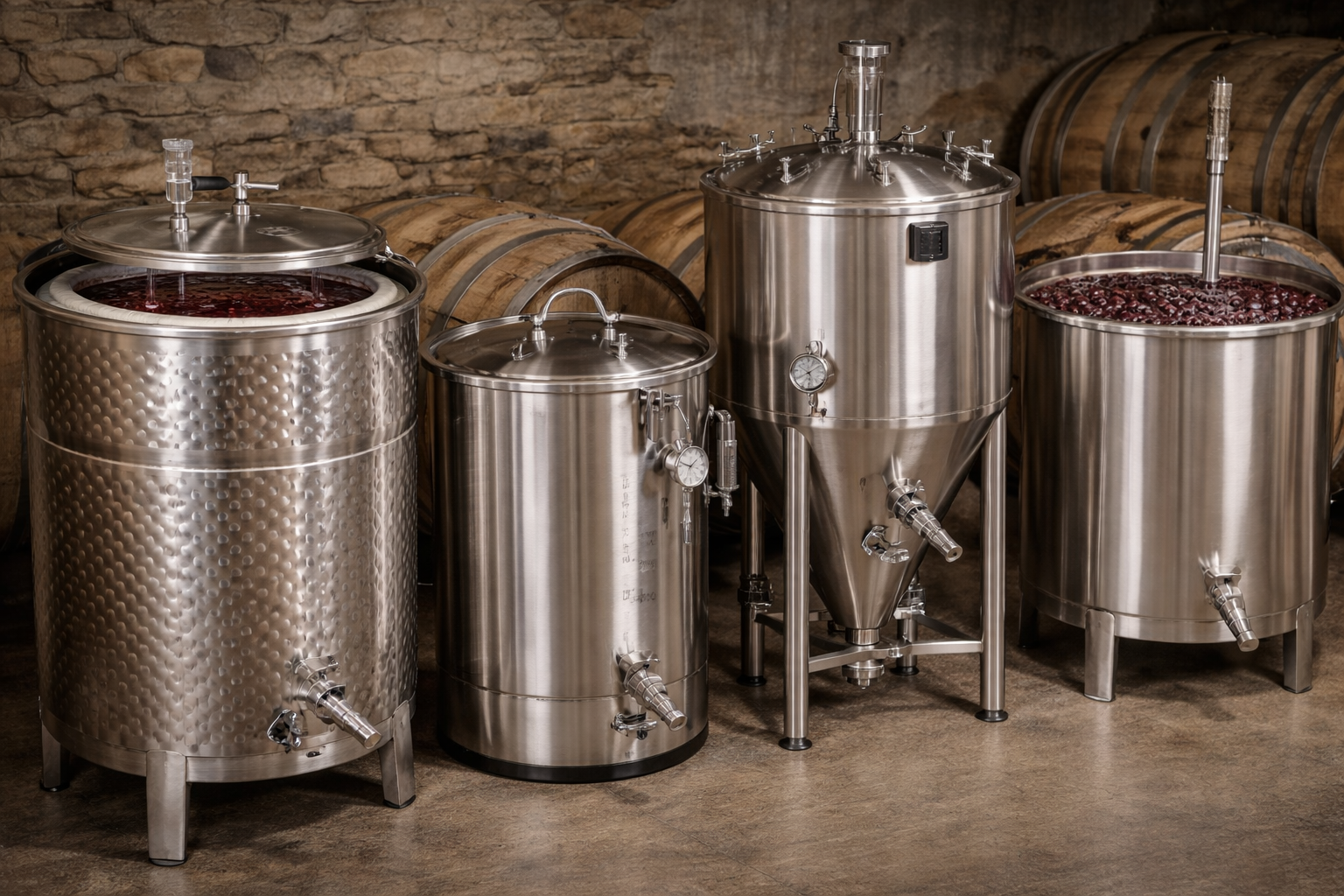
There are four vessel styles worth caring about here.
Variable-capacity wine tanks are the wine-first answer. You get a floating lid, a gasket that seals at the level of the liquid, and the freedom to run different fill volumes without leaving a giant air pocket. If you make wine often, this format feels sane. Boring, maybe. But sane.
Bucket-style stainless fermenters are usually the best crossover buy for home-scale batches. Wide opening. Easy cleanup. Easy to fit in a fridge or fermentation chamber. They work well for five- to six-gallon batches and do not ask you to adopt a mini commercial cellar routine in your garage.
Conical fermenters shine when you care about dump valves, modular fittings, and pressure handling. That matters a lot in beer. In still wine, some of those perks matter less than people think. You can make wine in a conical just fine, but a lot of readers pay for flexibility they never touch.
Open-top wine fermenters make the most sense for red wine on skins when punch-down access is the priority. Closed vessels can still work for reds, but if you fight the lid every day during cap management, you will stop enjoying the tank pretty quickly.
| Vessel type | Best for | Main drawback |
|---|---|---|
| Variable-capacity tank | Wine makers with shifting batch sizes | Bulkier, less common in small home setups |
| Stainless bucket | 5 to 6 gallon batches, easy cleanup | Less forgiving if final volume comes in short |
| Conical | Modular users, closed transfers | You can overpay for features still wine does not need |
| Open-top fermenter | Red wine with active cap management | Not ideal once oxygen control becomes the priority |
If you want a fast filter, use this one: reds push you toward access, whites push you toward control, and mixed batch sizes push you toward a floating lid.
Size the fermenter so your wine has room to work, but not room to oxidize
Most sizing advice on this topic is too vague to help. “Choose a tank based on your production needs” sounds fine, but it doesn’t tell you what to buy.
Here is the cleaner rule. Buy for your normal finished batch size, then add the space the wine needs during active fermentation. Do not buy for the once-a-year fantasy batch unless that batch is actually coming.
If you usually finish around 5 gallons, a 7 to 8 gallon stainless bucket is the normal starting point. That gives you room during primary fermentation without turning the vessel into a mostly-empty storage chamber later. If you regularly make 10 to 15 gallons, or your fruit yield swings, a variable-capacity tank starts making a lot more sense because the lid can move with the wine.
Here is where people get nicked. They buy too large “for future-proofing,” and then they spend the next year managing headspace with workarounds. Wine is not all that forgiving here. Penn State’s oxygen-management material makes the practical point in a more technical way: extra oxygen exposure is not a trivial detail in wine handling.
What to check first
- If your finished batch rarely lands on the same number, skip fixed-volume vessels unless you also have a second storage plan.
- If the vessel will live in a fridge or chamber, check width before capacity.
- If the opening is narrow enough to make scrubbing awkward, size stops mattering because cleanup becomes the real problem.
Buy the features that change your wine, skip the ones that just raise the invoice
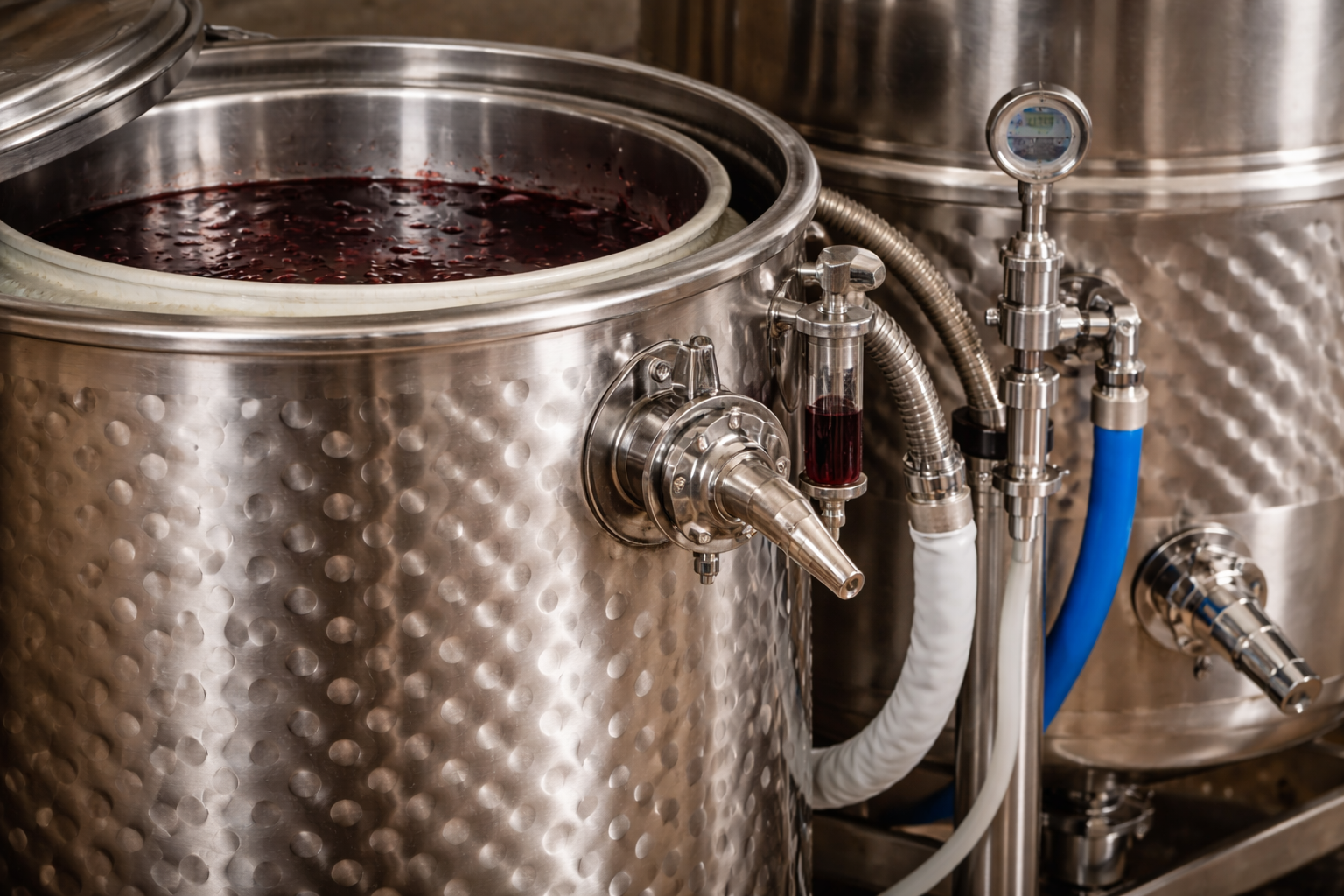
A lot of stainless fermenters look similar in photos. They stop looking similar after two messy transfers and one stubborn cleanup day.
The features that earn their keep in wine are usually plain: a smooth cleanable interior, a wide enough opening to actually wash by hand, a sensible drain or racking valve, and a seal that does not turn headspace into a habit. The FDA Food Code is not a winemaking buying guide, but it does spell out a principle that absolutely applies here: food-contact equipment should be nontoxic and cleanable. That sounds obvious. It is still the rule most people break when they buy a vessel with awkward access because the spec list looked fancy.
Temperature control sits in the “worth it if you need it” bucket. UC Davis lays out why fermentation management, including temperature, changes how yeast behaves and how aromatics hold up during wine fermentation. So if you make aromatic whites, or your fermentation space swings hard, built-in cooling or a reliable way to control temperature starts making real sense. For sturdy reds in a controlled room, built-in cooling is less urgent.
Pressure capability is where many buyers drift off course. It sounds advanced. For still wine, it is often a side quest. Nice if you like closed transfers. Not a reason by itself to pay a lot more.
Tri-clamp fittings, sample valves, thermowells, and jacket ports are all useful in the right setup. But the best feature is still the one you use every batch. A beautifully engineered dump valve that never actually solves a wine problem is just polished clutter.
Choose 304 for most cellars, step up to 316 only when your conditions justify it
The steel-grade discussion gets weirdly dramatic online. It does not need to be.
The Nickel Institute’s design guide notes that Type 304 is the most widely used austenitic stainless steel, while 316 adds molybdenum and improves corrosion resistance in tougher service. That is the technical base. The buying conclusion is this: 304 is the normal choice for home wine fermenters, and it is enough for most readers.
Move up to 316 if your environment is rougher than normal, such as a coastal setting with more chloride exposure, or if you are investing in a long-term welded tank that will see heavier chemical use over years. But do not treat 316 as a magic stamp of quality. A badly designed 316 tank can still be more annoying, less sanitary, and less useful than a well-finished 304 vessel.
What matters just as much is weld quality, interior finish, gasket quality, and the basic geometry of the fermenter. I would take a well-made 304 tank with smart valve placement over a sloppy 316 tank every day of the week.
Match the fermenter to the wine style you actually make
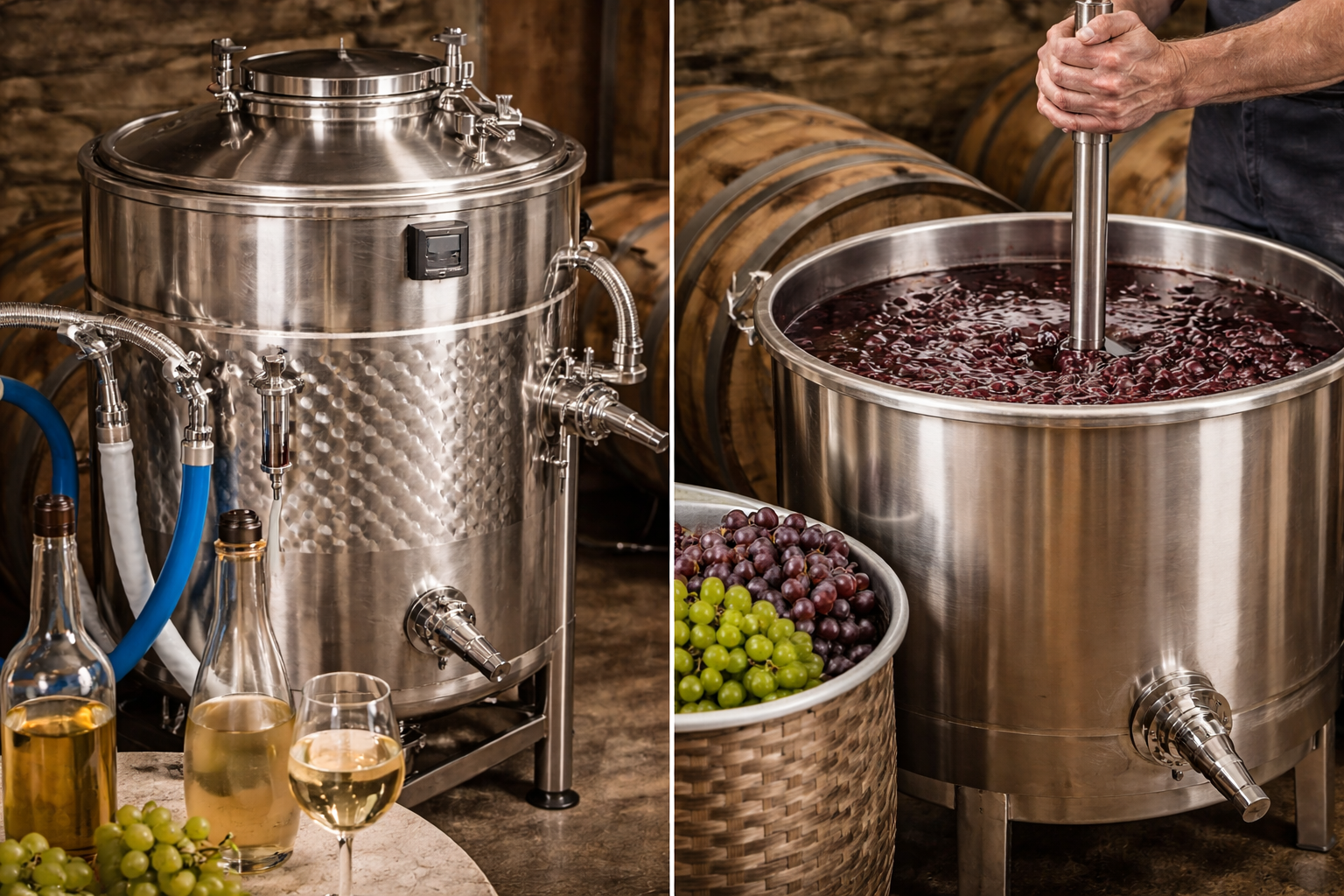
Wine style changes the recommendation more than many buying guides admit.
For crisp whites and aromatic wines, tighter oxygen control and steadier fermentation temperature matter more. That pushes the decision toward a vessel with a better seal and a cleaner temperature-control path. UC Davis calls out temperature as a core fermentation-management variable, and white wines are often the place where sloppy temperature control shows up fast in the glass.
For red wines on skins, access matters. A vessel that looks tidy in a catalog can feel ridiculous once you are trying to manage a cap every day. Open-top stainless fermenters, or at least wide-access vessels, make more sense here.
For fruit wines and small trial batches, cleanup and flexibility often matter more than prestige. This is where people go wrong by buying the stainless equivalent of medium shoes. They fit well enough until you actually have to walk in them all day. A vessel that is “good at everything” can still be a poor fit for the batch sizes and wine styles you really make.
If you are still early in the hobby, a full stainless upgrade may be premature. A solid beginner setup like the options in this guide to beginner wine making kits often makes more sense until batch size, routine, and wine style settle down.
Use this buying framework to narrow the field in five minutes
Do this in order. Brand names come later.
Step 1. Lock your true batch size and avoid fantasy sizing.
Write down the batch size you actually finish most often. Not the one you hope to make after harvest “gets serious.” Buy for the pattern you already have.
Step 2. Decide whether you need variable volume or fixed volume.
If batch size swings, go variable-capacity. If your batches stay tight and small, a stainless bucket or compact conical is easier to live with.
Step 3. Decide how much temperature control you really need.
For whites in a warm space, built-in cooling or a fridge-friendly footprint gets a lot more valuable. For reds in a stable room, the premium is harder to justify.
Step 4. Eliminate vessels that are annoying to clean.
This one is under-rated. Penn State’s winery cleaning review is clear that proper cleaning and sanitizing are not optional, and stainless can still be damaged by the wrong chemistry or rough treatment. If the vessel fights you during cleanup, your process will get sloppy.
Step 5. Compare valve placement, sample access, and transfer ease.
Now you can start looking at products. Not before.
Still in doubt? Here’s a fast guideline to save you some time.
Choose a floating-lid tank if headspace is your main worry.
Choose a stainless bucket if cleanup and everyday convenience matter more.
Choose a modular conical only if you know you will use the ports, transfer options, or pressure features.
The best stainless steel fermenters for wine by buyer type
These picks are not all built for wine first. That is the point. Most readers shopping home-scale stainless gear will cross into beer-oriented equipment whether they planned to or not. So the useful question is not “Which tank looks most winery-like?” It is “Which tank gives a wine maker the least friction for the job?”
Speidel Variable Volume Tank
If you want the most wine-specific answer, this is the one. Speidel’s variable-volume tanks are built around the thing wine buyers actually need: a floating lid that moves to the wine instead of forcing the wine to rise to a fixed lid. Retail listings for Speidel’s laser-welded variable-volume tanks call out the floating lid, the proprietary gasket, and 304 stainless construction with a finish designed to clean up easily. That matches what makes these tanks attractive in practice. You are buying volume flexibility and headspace control first, not just shiny steel.
In use, this style feels less flashy than a jacketed conical and more useful for actual wine. Fermentation finishes short? Fine. Need to hold a partial lot for a bit? Fine. Want one tank that can take fruit from active fermentation into a quieter settling phase without forcing you to scramble for a second perfectly sized vessel? Also fine.
The tradeoff is footprint and sourcing. These are not always the easiest home-scale tanks to find, and they are not the prettiest fit for cramped indoor spaces. They are also less plug-and-play for readers who want a small all-purpose fermenter that slides into a fridge.
Best for: wine-first buyers, mixed batch sizes, bulk aging or short storage in the same vessel.
Skip it if: you only make steady five-gallon batches and want a compact vessel that is easy to move alone.
SS Brewtech Brew Bucket 2.0
This is the pick I would hand to most home winemakers making standard-sized batches who want stainless without turning the hobby into a cellar engineering project. SS Brewtech says the Brew Bucket 2.0 has a full-width removable lid and a repositioned thermowell in the lid, and that full-width opening matters more than it sounds on paper. It makes cleaning easier, lets you see what is going on, and reduces the silly little frustrations that come from trying to scrub around bad access.
For wine, the Brew Bucket 2.0 works because it gets the basic stuff right. Wide access. Stainless body. A bottom setup that is useful for transfers. A footprint that is friendly to small fermentation spaces. It is not pretending to be a winery tank, and honestly that is part of its charm. You can ferment five or six gallons of wine in it, rack out cleanly, and clean up without feeling like you are dismantling lab equipment.
Where it loses ground is variable volume. If your batch lands short, you do not get the floating-lid safety net that a true wine tank gives you. So the Brew Bucket is strong for stable batch sizes, but weaker for harvest swings or mixed lots. For a lot of readers, that trade is still worth it because the vessel is so easy to live with.
Best for: most five-gallon home winemakers, crossover fermenters, buyers who value easy cleanup.
Skip it if: headspace flexibility is your number-one concern.
Anvil Stainless Bucket Fermentor
Anvil’s stainless bucket fermentor has stayed popular for a reason. The product details commonly listed across sellers are consistent: 304 stainless steel, coned bottom, rotating racking arm, embossed level markings, and a simple bucket form factor. That combination hits a sweet spot for buyers who want stainless without spending into conical territory.
What I like here for wine is the lack of drama. It is a bucket. A good one. The opening is generous. The racking arm helps. The shape is easy to wash. If you are moving up from glass carboys or plastic buckets, it feels like a practical upgrade rather than a personality purchase. There is less to assemble, fewer fittings to baby, and less temptation to spend weekends tweaking accessories you do not need.
The compromise is refinement. The lid and sealing system are simpler than what you get on more modular premium fermenters. For still wine, that is often fine. For buyers chasing tightly controlled closed transfers or more add-on hardware, this starts to look basic pretty fast.
Best for: value-minded buyers, straightforward five- to seven-gallon batches, winemakers who want stainless with minimal fuss.
Skip it if: you want more modular ports, pressure-related features, or a more premium fit and finish.
Spike Flex
The Spike Flex is the choice for readers who know they want a more modular stainless fermenter and are actually going to use those features. Spike lists the Flex as 304 stainless with sanitary welded ports, etched volume markings, polished finish, and a 7-gallon total capacity designed for 2.5 to 6 gallon batches. It also supports low-pressure transfers. Those are not throwaway specs. They describe a vessel built for users who care about fittings and workflow, not just a container with a lid.
For wine, the Flex earns a place because it gives you cleaner transfer options and stronger modularity than a simple bucket fermenter. If you like tri-clamp gear, clean disassembly, and the option to expand your setup over time, this is a strong platform. The sanitary welded ports are a real plus.
But there is a catch. If your main job is still wine in ordinary home-sized batches, the Flex can edge into overkill. You are paying for a chassis that rewards people who enjoy modular fermentation hardware. If that is you, great. If not, the extra cleverness does not buy you better wine by itself.
Best for: modular-minded buyers, closed-transfer fans, readers who want a flexible stainless platform.
Skip it if: you want the easiest path from juice to carboy replacement and do not care about extra ports or low-pressure transfer options.
Avoid the mistakes that make stainless feel overrated
Buying too large. This is the big one. People call it future-proofing. Often it is just paying extra for headspace management problems.
Buying pressure features for still wine. Pressure capability is useful in some setups. It is not a badge of seriousness. A lot of still-wine buyers pay for it and barely touch it.
Ignoring cleaning access. A vessel with awkward access always looks better before first use than after third use. Penn State also notes that sanitizer choice and cleaning chemistry matter with stainless equipment. So the material does not rescue bad maintenance habits.
Assuming any stainless tank is automatically sanitary. Smooth finish, weld quality, gasket condition, and how you clean the thing all matter. Stainless gives you a good starting line. It does not do the work for you.
Forgetting that wine and beer ask different things from a fermenter. Beer gear crosses over well in some cases. It does not erase the wine-specific issue of headspace and longer contact time in the same vessel.
Small but real safety note: full stainless vessels get heavy fast. Spike’s own support note warns against lifting a full Flex because sloshing liquid can throw off balance. Casters, lower-fill transfers, and plain caution beat “I can probably carry this.”
Know when not to buy a stainless steel fermenter yet
Sometimes the best move is waiting.
If you are still making tiny experimental batches, still learning what styles you like, or still sorting out temperature control in your space, stainless may be the second purchase, not the first. A lot of beginners blame their vessel for problems that actually came from warm fermentation, poor sanitation, or unstable process.
This is especially true if you are making one-gallon or occasional small-batch wine. A stainless fermenter can be lovely, but it is not always the bottleneck. Plenty of readers are better off dialing in the process, then moving to stainless once batch size and routine stop bouncing around.
If that sounds like you, a simpler setup from a beginner-focused kit will usually make more sense than jumping straight into standalone stainless gear. There is no shame in that. It is often the smarter route.
FAQ
Is a stainless steel fermenter better for wine than a glass carboy?
For many home winemakers, yes. Stainless is easier to clean, less fragile, and usually easier to handle in daily use. Glass still works well for small stable batches, but stainless becomes more attractive once you care about durability, valve access, and reducing the hassle of cleanup and transfers.
Can one stainless fermenter handle both fermentation and short-term wine storage?
Yes, though the vessel type matters. Variable-capacity tanks are strongest here because they let you control headspace as volume changes. Fixed-volume buckets and conicals can do both jobs too, but they ask for tighter batch-size control or a separate topping and storage plan.
Is a conical fermenter worth it for still wine?
Only if you will use the conical’s extra hardware. For still wine, a conical can work very well, but the jump in price and features does not automatically give you a better outcome than a simpler stainless bucket or a floating-lid wine tank.